Accompanied by music
NO OBVIOUS SOURCE OF INSPIRATION. I am not sure when I became conscious of music as elemental. Up to my teens there was always a piano in the house, but it was used mainly to play the hymns as my father planned the next Sunday’s services. I was ten when we left Bristol for Leeds, at which point I departed for prep school in Berkshire and I sense that it must have been there where I started having piano lessons. I arrived at Kingswood, the main school in Bath, aged twelve and the piano lessons continued until I had the opportunity to hear a well-known clarinet player (it was not Gervase de Peyer but someone of that ilk). It was at the nearby girls boarding school - the Royal School for the daughters of army officers! At that time such was the concern that something inappropriate might happen when the genders encountered each other that those of us who wanted to go the concert were escorted across the road to the girls’ school and into a side entrance which brought us through a tunnel up into their school hall where we were placed in the front row so that all the girls were behind us - out of sight!
I remember listening to the melodious and sonorous sound of the clarinet and decided then and there that this was the instrument for me. In my next letter home - which at the time was the only form of communication between pupil and parent - I asked if I could have clarinet lessons. This raised two issues - the capital cost and the operating costs. To play I needed a clarinet (capital cost) and I also needed lessons (operating costs). Putting the capital cost to one side, the response came that even if I could find a clarinet they could not afford to pay for both piano and clarinet lessons. As the letters continued, I confirmed that if it could only be one instrument then it should be the clarinet. And so in due course that came to pass.
What happened next escapes the grey cells of mind and I must have had some lessons using a hired instrument to ensure my competence and interest, as when I next got home there it was - my new clarinet in its case with a mottled beige exterior. It was sitting in its component parts in soft red material, made by Selmer of African ebony. I understand that it had cost £30 (around £700 in 2025). As at the time my father’s salary was only £500 a year (around £12,500 in 2025) then I can only assume that a generous member of the church congregation had paid for it.
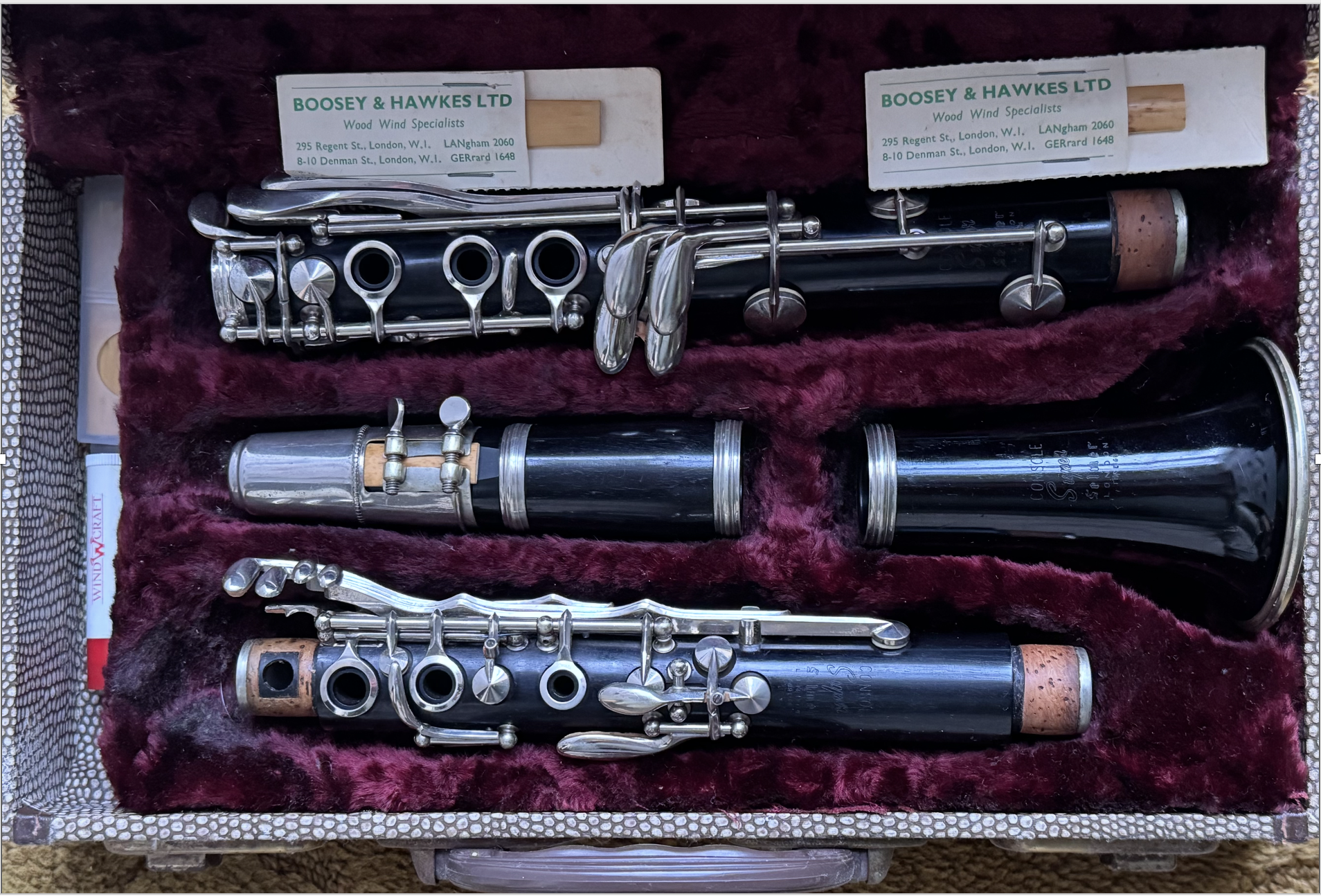
At the end of two years of piano tuition, by which time I had passed Grade V, the piano lessons ceased. There must have been some natural musicality in my genes as I continued to play both piano and organ, can still play by ear and later composed music for both piano and orchestra.
MUSIC - A SAVING GRACE IN UNHAPPY TIMES. My clarinet lessons were with the unforgettable Les Gollege who, when he was not giving lessons, led the band at the Pump Room in Bath - where Acker Bilk also occasionally played. Les had a rosy face, twinkling eyes and a clipped moustache - his wiry hair combed straight back, curling up a little at the back. He was generous to a fault and, reading my passion for the instrument, gave me a lot of attention and encouragement. In the sixth form, knowing that I hated gym - where the gym master (later sacked for beating a boy) picked on a few of us seemingly weedy specimens - Les somehow managed to arrange my lessons so that they always coincided with gym and I could justify my absence.
Although he played both swing and jazz he could sense my inclination towards classical musical and nurtured it. It was only when I got to university that I came across the likes of Chris Barber’s Jazz Band and wished that I had learnt to extemporise. Whilst I could play Petite Fleur and seek to emulate Sidney Bechet I never learnt the freedom of being given eight or sixteen bars in which to let my fingers flow and extemporise. As mentioned, later I came to regret this when Tom, then 15, joined Jazz Friday - a small group of largely older amateur musicians in the Stroud area who met on a Friday under the baton of a local peripatetic music teacher. Whilst Tom could bounce confidently around the keyboard during his 16 bars of extemporising, I found myself pretty much restricted to a string of arpeggios.
Back at school the music room, whether for piano or clarinet, was where I could escape and be myself - practising for hour after hour, whether simply wanting to play better or in preparation for a concert. The school orchestra provided a welcome host for my interest and growing aptitude, where we played under the direction of Bill Sykes the music master. Clearly a capable and committed musician and composer, Bill was one of the many masters at the school who I now realise had been damaged in WW2. He had experienced shellshock and his still-black hair grew long over his ears and collar. His complexion was ruddy, he was often unshaven, a cigarette was generally hanging from his lower lip and he smelt strongly of beer - which was surprising in a Methodist boarding school. He lived alone in the school tower and on the occasions that we visited his room he would be sitting at his piano surrounded by chaotic piles of music. He directed the orchestra well but sometimes seemed to be in a world of his own. On occasions we might reach the end of a piece of music whilst he continued to conduct the ensuing silence - seemingly unaware that the piece had ended.
FROM WOODWIND TO ORGAN. One of the benefits of being alongside Bill was that he would encourage you to play the organ when there was no-one in the school chapel - and so I spent many hours learning the different stops and how to play the pedals. I had a go at playing Bach’s Toccata and Fugue in D Minor, which must have sounded pretty grim to anyone listening outside, but for me was a lot of fun and - as can be seen below - it gave me the confidence to play the organ at weddings and funerals when back in the Peak District. And when up at university in Newcastle, John Barratt (my contemporary) asked me to play the organ when he married Rita in the Methodist Church in Wembley in the summer of 1968.
A GOOD TREBLE VOICE - A MIXED BLESSING. During my early years at secondary school it transpired that I had an exceptionally good treble voice and as a result was asked not only to sing in the church choir but also to sing solos on a fairly regular basis. Whilst I enjoyed the singing, I did not enjoy the exposure of being in the spotlight. Boarding school can be a pretty cruel place, or certainly could be in those days, and people like me who clearly did not excel in any of the physical sports (rugby, athletics, cricket, tennis, swimming etc) and seemed a bit weird were an easy target. Being a star treble singer - not one of the physical sports - made one an easy target. Once my voice broke it ceased to be exceptional - although it continued to serve me well for many years to come - and I could hide away from the madding crowd.
MUSICAL FRIENDS. The two close friends that I had at school were both interested in music - although only one of them was a musician (John Baird) and the other (Robert Mules or Muffin - whose father was a Methodist missionary teacher in The Gambia) was more interested in philosophy and literature. We were brought together originally because we were more interested in things cultural than things sporty and were generally side-lined by others. The three of us would regularly go for walks where we would talk about music and literature and address the eternal theme of whose music was the greatest - Bach, Beethoven or Mozart? It was a subject to which there is no answer and therefore can be asked day after day and offer opportunity to provide even more reasons to support one’s point of view.
It was perhaps fitting that my last musical activity at school was to play the first movement of Mozart’s Clarinet Concerto with the school orchestra conducted by John Baird. The three of us lost contact after leaving school but I managed to catch up with John (who had become Head of Music at Westminster College and conducted the Medici Choir) in early 2015 – bizarrely through a request on Linked-in to get in touch with a Penny Baird. I rarely use Linked-in and did not know who Penny Baird was. But she made the link by asking if I knew a John Baird – who turned out to be her husband. He later sent me a tentative email which read…”Are you the John Meadley who played the clarinet brilliantly and who was one of my best Kingswood friends? If so, it is good to know. I am still composing and teaching. Perhaps you are not the John Meadley whose father was a minister at Cliff College. It not, I apologise. If you are I’d love to hear from you. I have a website. The dialogue continued, although spasmodically as he was having medical tests, but eventually they came to stay with us in the Cotswolds when piano and clarinet played together for the first time since 1959.
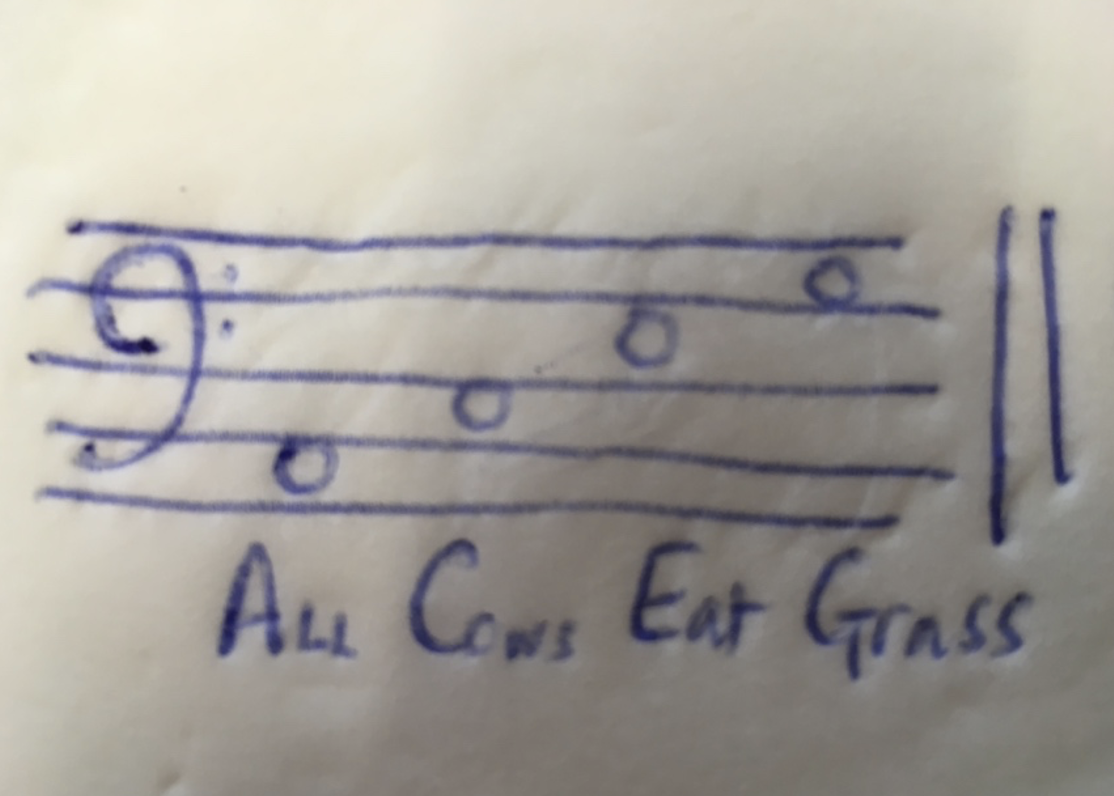
We later met for coffee in London. I remember that when I explained to him about Pasture for Life and cows only eating grass he asked “but don’t all cows eat grass?” He then went on to explain that “all cows eat grass” is the phrase used to remind students of the black lines in a scale – with the notes between them being ACEG! I drew this on a serviette to delineate the five black lines and it looked just like a five-bar gate. Hence the link with the pasture was made!
John and I kept in touch following that meeting in the café and in July 2017, sadly shortly after his wife died, he came to Fiona’s “Echo Chamber” exhibition in Friends House. We stayed at his house overlooking Wandsworth Common where we played again the first movement of Mozart’s clarinet concerto – echoing our playing of the same on Speech Day in 1959. Whilst John’s piano playing was – not surprisingly for a music teacher – near perfect,3 mine on the clarinet was somewhat rusty. Despite this, the sound that emerged was clearly recognisable for what it was and brought back much joy and a flood of memories.
John died in September 2018. I joined a celebration of his life on the P.S Waverley on the Thames – the world’s last ocean-going paddle steamer. We were reminded that “Both John and the Waverley’s engines hail from Greenock and since his childhood the two have sailed together for many thousands of nautical miles. From the Firth of Clyde and Arran, the Bristol Channel, round the Isle of Wight and along the Thames to Southend and beyond, John has certainly clocked up enough miles to circumnavigate the globe at least once!" It was a memorable evening as we sailed up the Thames to Greenwich and back – to the pounding of the engines and to the soaring music of Beethoven, Bach and Mozart.
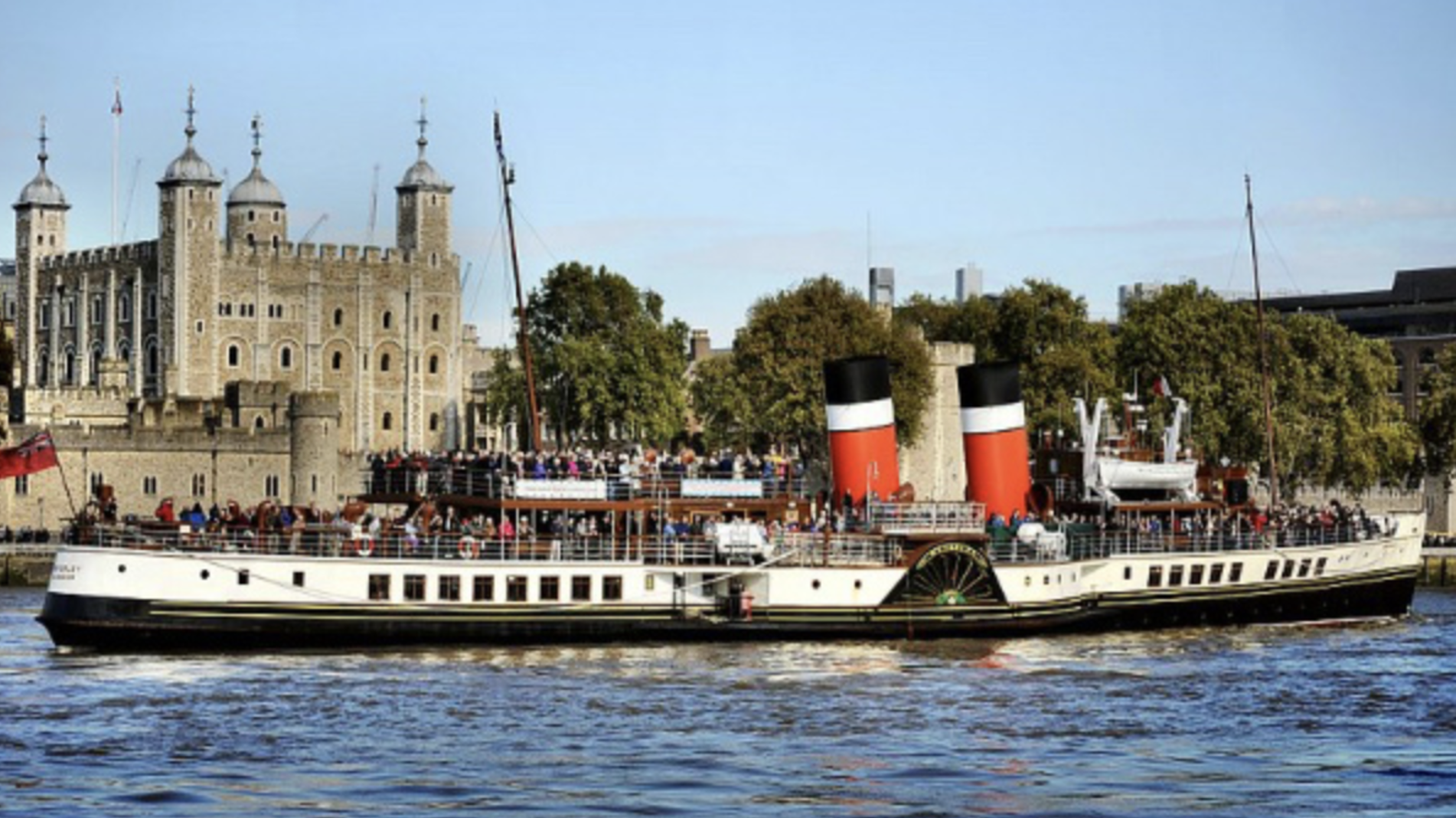
PS Waverley passing the Tower of London
MUSIC OR SCIENCE? Whilst at the prep school, at the tender age of eleven, the headmaster asked me what I wanted to do when I grew up. Having been told that a steam-engine-driver was not on the list I opted for being “a vicar like my Dad” – which resulted in my being allocated to the classical stream. At the age of 16 I had already completed my entirely non-science suite of O levels and embarked own my entirely non-science A levels (English, French and Geography) when I “found” farming and decided to pursue it as a career - a career in which having some knowledge of “science” could not only be useful but also essential. After A levels (and famously failing English) I stayed on for a further year to study Biology and Geology - my first experience of “science” - to help prepare me for a career in farming. Studying A level biology, without having studied any biology before, was a struggle. At the same time, I wanted to play the solo in Mozart’s Clarinet Concerto in my final end-of-year concert - together with the school orchestra under the baton of the afore-mentioned John Baird. As this required me to practice 2-3 hours a day I gave up Geology A level so that I could play the clarinet concerto and get through Biology A level.
A CLARINET NEEDS COMPANY. The clarinet requires company - be it piano, string quartet, orchestra or jazz band. Once I left school the existence of such “company” largely fell away. For the next 12 months I was undertaking my farming practical - firstly in South Derbyshire where I was up to 0530 for milking and at the end of the day getting on my BSA Bantam motorcycle to ride into the local town to study more Biology as well as A level Chemistry - a subject entirely new to me. After six months I returned to the home farm in the Peak District where a similar routine pertained with neither the time nor the company to make music. Although my clarinet playing continued over the years ahead, this was the first time that I became conscious that the clarinet needs friends in order to express itself.
MUSIC UP NORTH. September 1961 found me on my way to university at Newcastle upon Tyne to study agriculture - although in practice I had to undertake yet another (preliminary) year to study botany, zoology and chemistry to make up for the complete absence of any science in my education until I was 17. During my four years at Newcastle the clarinet largely stayed in its case and I played the piano only to accompany hymns at the Methodist Society. Meanwhile, when back at home, I would occasionally be asked to play the organ at a local wedding or funeral at the end of which I would be given a fiver - some of the few occasions where I actually got paid for doing something.
THE LURE OF THE GUITAR. One of the people I was close to whilst at Newcastle was John Barratt, whom I met in my first year whilst in hall. He was studying to be a probation officer, a topic which suggested a spirit interested in humanity, and we struck up a friendship. He played the guitar and wanted to start a pop group to sing the songs of The Beatles amongst others. He had found someone else who played the guitar and wanted a couple of others who could sing to make the up four and add some harmony. And so, for the first time (but not the last), I found myself singing on stage with a group.
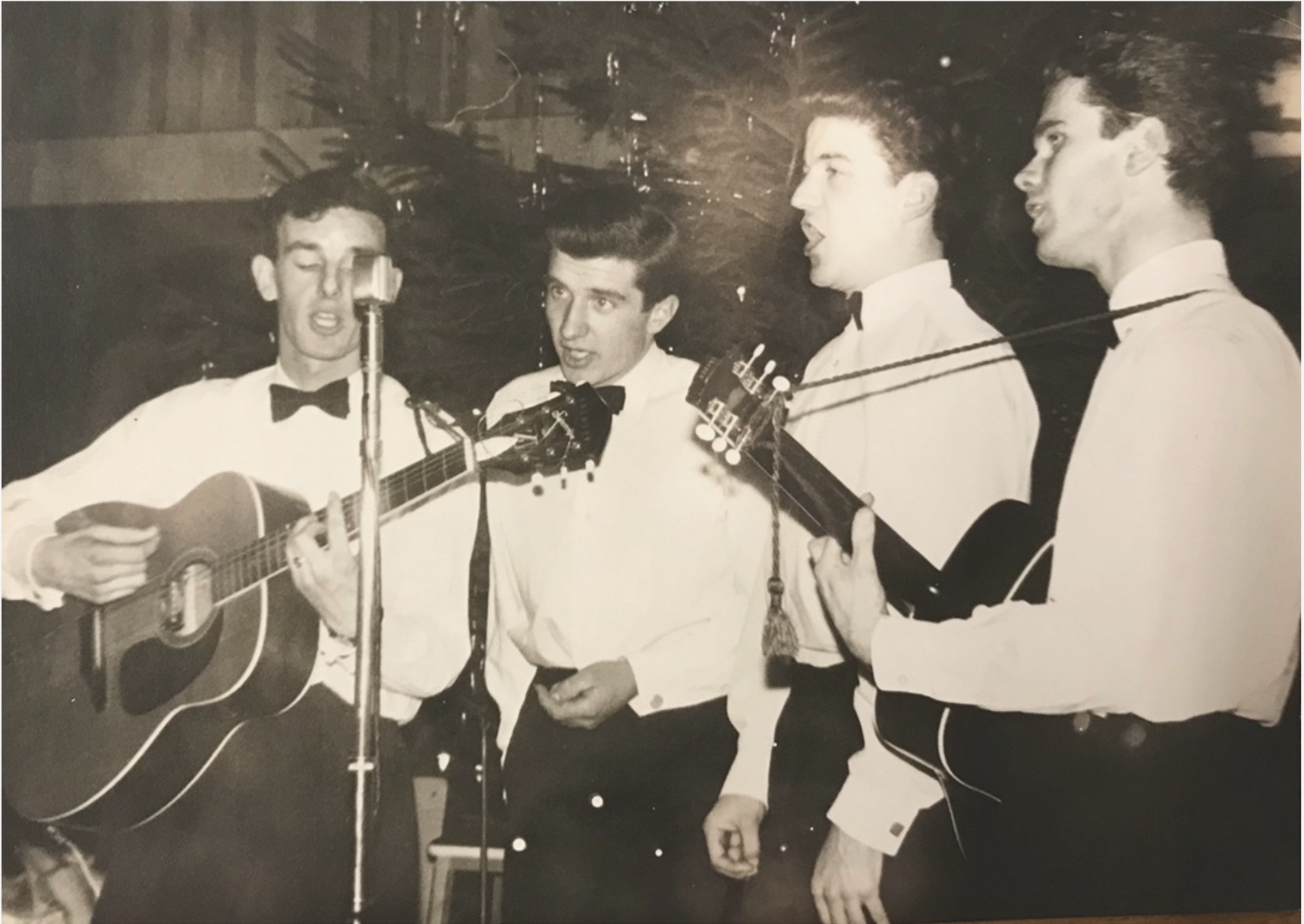
Singing the Beatles songs when a student at Newcastle. John Barratt is to my right.
This experience encouraged me to teach myself the guitar. I also quickly learnt how someone with a guitar in his or her hand can be welcome pretty much anywhere. It was whilst I was at Wye College engaged in my postgraduate studies (see below), probably aged around 24, that I set off by myself for Austria. I didn’t speak a word of German - but I had my guitar. And with this to hand I made my way to Innsbruck from where I set off for Salzburg – Mozart’s birthplace.
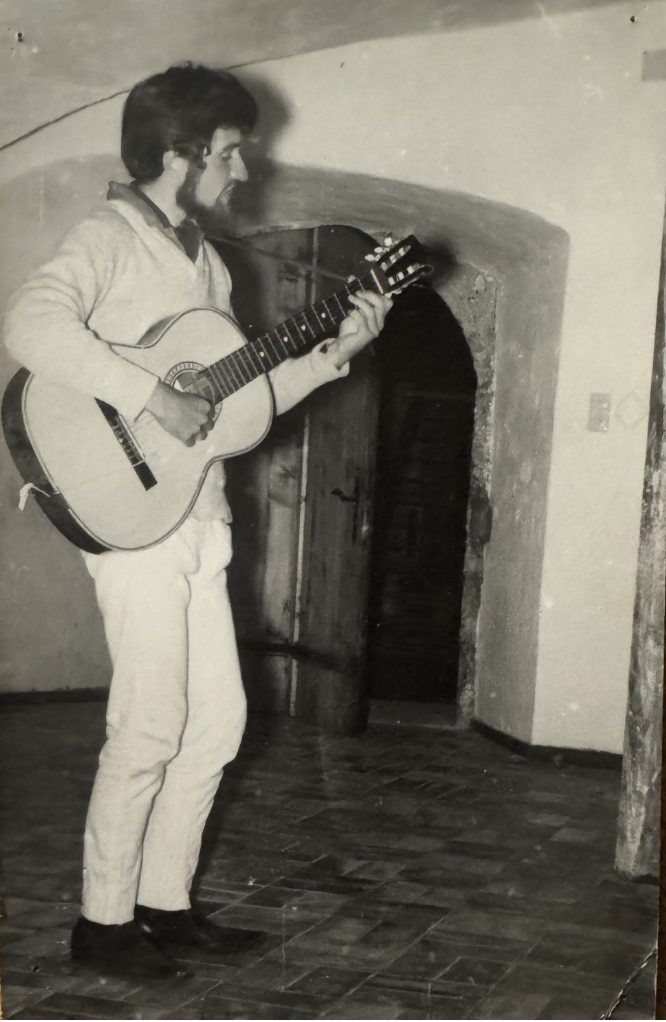
Leading the singing at a youth hostel in Austria
I had no plan, no timetable and no itinerary. Sometimes I walked but mostly went by public transport. I learnt that the German for a farmer (peasant or rustic) is Landwirt and that agriculture is Landwirtschaft. Sometimes I hitchhiked. Sometimes I got the train. I stayed in youth hostels and without fail was asked to entertain the assembled company with my guitar. In one town I stopped by for a wee in a public toilet. To my amazement there was the most amazing harmony coming from the cubicles behind me - out of each of which in due course emerged four young Englishmen. They explained that they were experimenting with the acoustics of different public toilets in Austria - part of their wider interest in which surroundings best reflected their voices. They also told me that they planned to launch themselves as a group - and planned to call themselves “The Kings’ Singers”. They were, indeed, the four young men who became the internationally famous “Kings’ Singers!”.
TO THE SOUTH OF ENGLAND. Leaving Newcastle heralded a period of change - not only moving on to postgraduate studies at Wye College but also leaving the straight edges of the Peak District and the farm, where I had fallen in love with the land, for a new family home in the soft, warm curves of Devon. Moving to Wye was a shock - recounted elsewhere - but in essence there was a modal shift from the directness and general poverty of the north to the relative wealth and softness of Kent – and where the Principal rode to hounds! Once again, it was music that saw me through.
THE FOLK CLUB. Back at Wye it was not long before I made my way to the College Folk Club with my guitar where, in a relaxed environment, we took it in turns to sing. I struck up a friendship with Chris Baines (who played the spoons and sang and who went on to be a leading independent environmentalist), Pete Wright (who played the mandolin) and John Beath (a Scotsman who sang songs from his homeland). They are in the photo below – with Pete Wright on the left of the group with the mandolin, John Beath on the right of the group with the guitar standing next to Chris Baines – on the fence). Here you can hear Chris singing “I was the child” some years later with the Albion Band. It may, or may not, be significant that all of us came from north of the Humber.
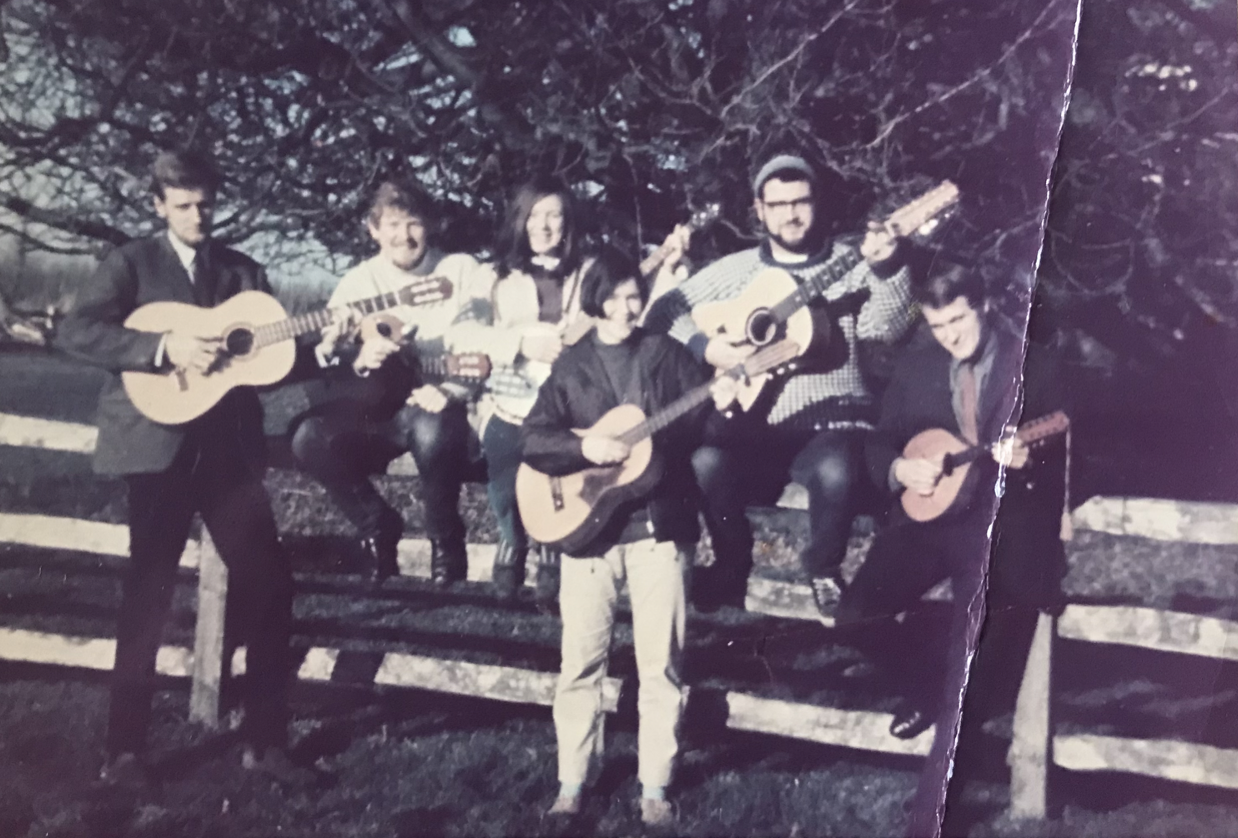
John Beath, Chris Baines, Patricia and Marjorie Holmes, Keith Packard and Pete Wright
Perhaps because of the monotony of my research work, which required endless hours of snipping and counting, I found myself writing jingles and light-hearted songs of which the first, and probably the best known, is “Why a peanut’s got a complex” - followed by The Mushroom Rock and Roll and Windy Wye. The club seemed to appreciate and welcome this light-hearted creativity and encouraged me to do more.
THE MUSIC SOCIETY. As well as the folk club there were two or three Sunday Night Concerts each term - organised by the Wye College Music Society - where those of us with a musical bent could perform. There were a couple of excellent pianists and a madrigals group whilst some of the overseas students liked to sing their traditional songs from back home. One of the people in my year with whom I had struck up a friendship was Sue Cook, who was an excellent flautist whilst Patricia Holmes – (see photo above - one of the daughters of Prof Holmes (my head of department) - was a good cellist. These, and others, provided the basis for re-establishing a college orchestra - in which my PhD supervisor (Prof Graham Milbourn) was the first violin! There was a certain irony in being able to ask my research supervisor to “play a little softer” or “watch the baton!”. The Music Society also produced musicals and whilst I was there we did Salad Days (which I directed) and HMS Pinafore as well as The Knight of the Burning Pestle.
PUTTING PEN TO PAPER. The combination of my own creative urges and the existence of the music society and its members provided the matrix for me to write some music, which included the following:
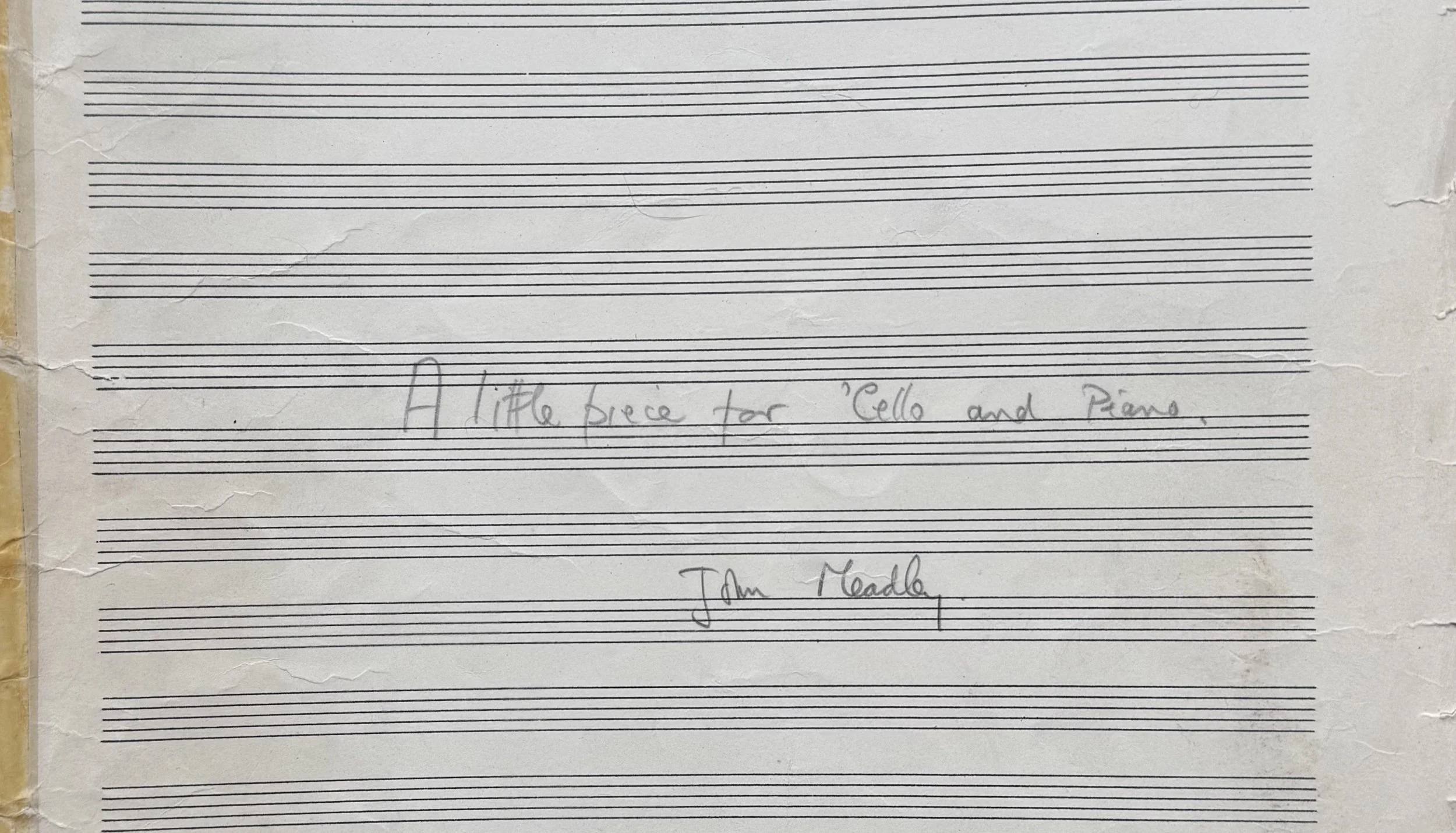
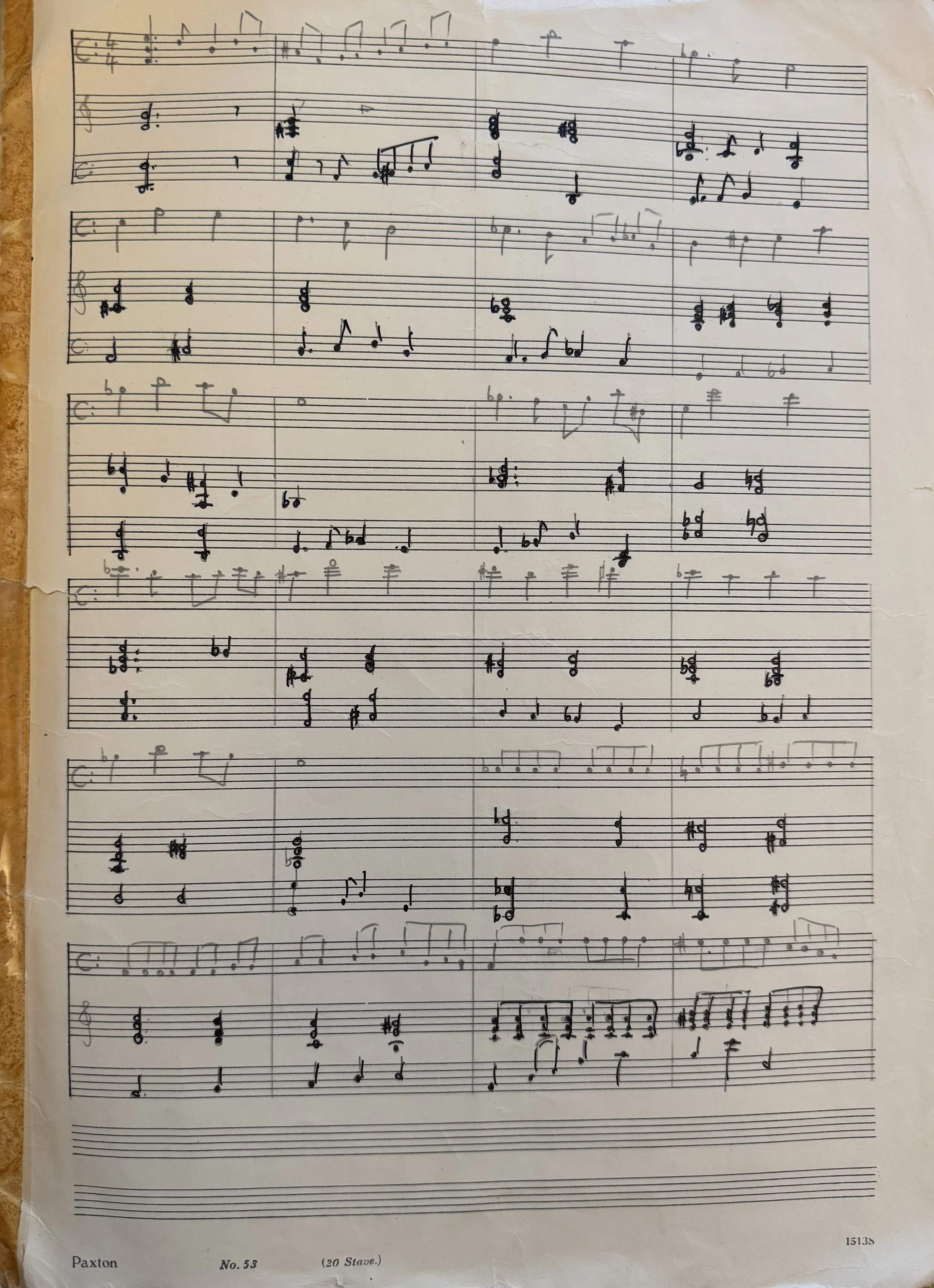
◦ For Prof’s daughter Patricia I wrote a piece for cello and piano in which I accompanied her. She said that she liked the piece except that I had clearly never played the cello or I would never have required her to play such a difficult combination of chords and sequences with the associated contortions of fingers required of her! Below the title page you will find the first page of the music which, although tuneful, looks like I had never played the cello!
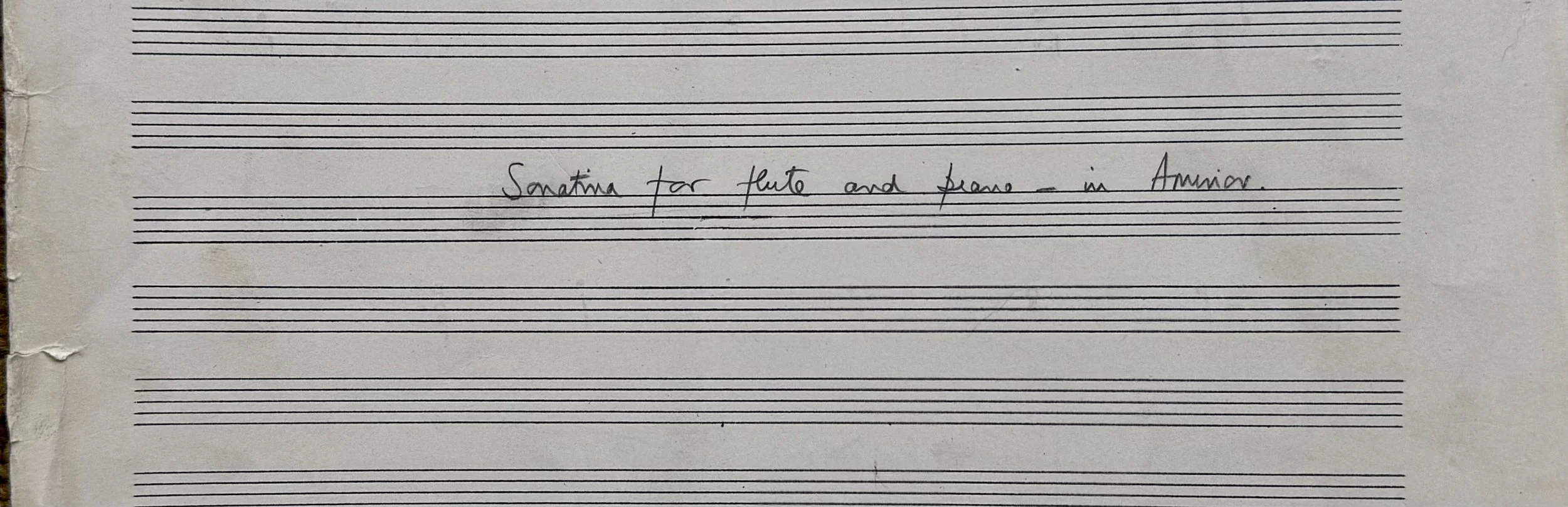
◦ For Sue Cook I wrote a sonata for flute and piano
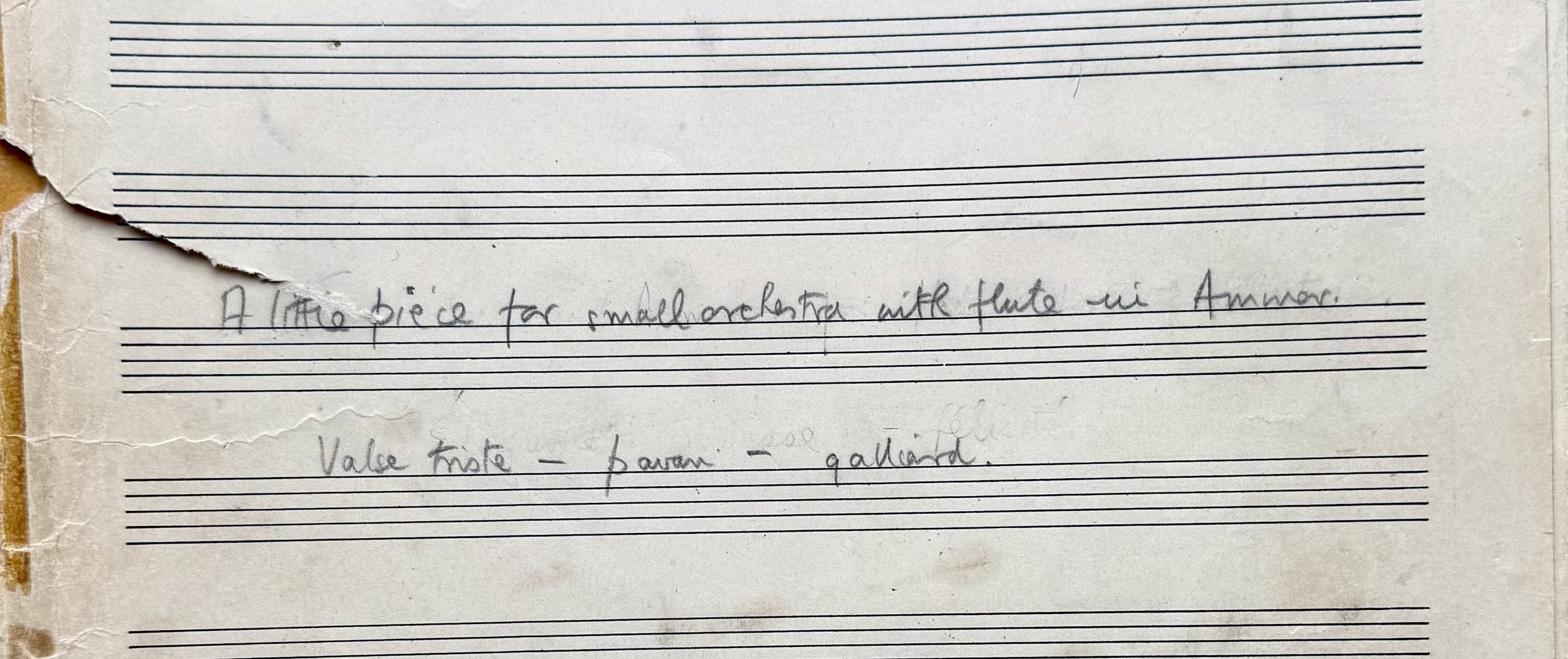
◦ As well as one for flute and a small orchestra
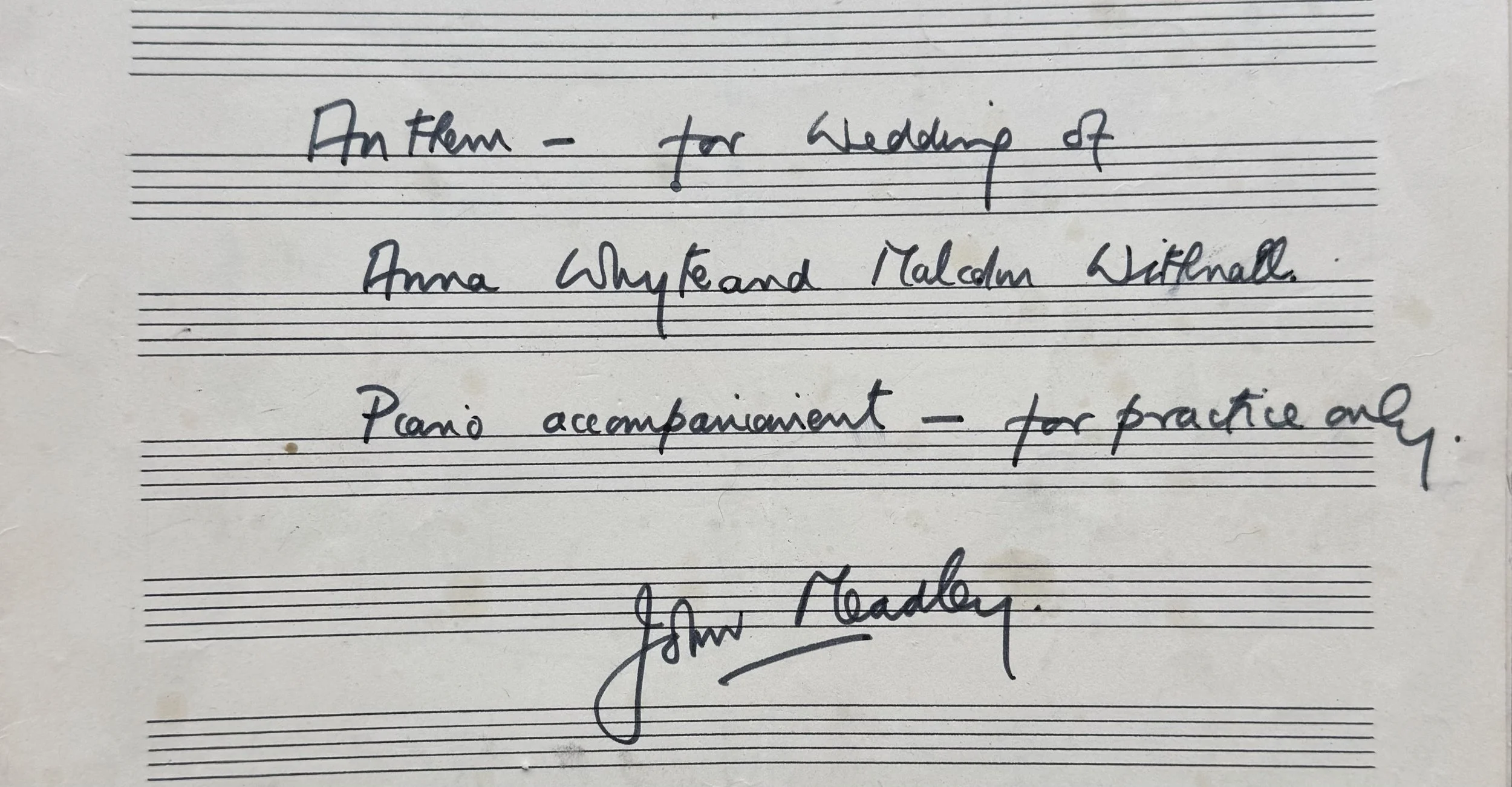
One of my close friends was Anna Whyte, who was doing a PhD on the potential to recognise apple varieties from the morphology of their pips! When she got married to Malcolm (Withnall) I wrote an anthem for their wedding which was sung acapella.
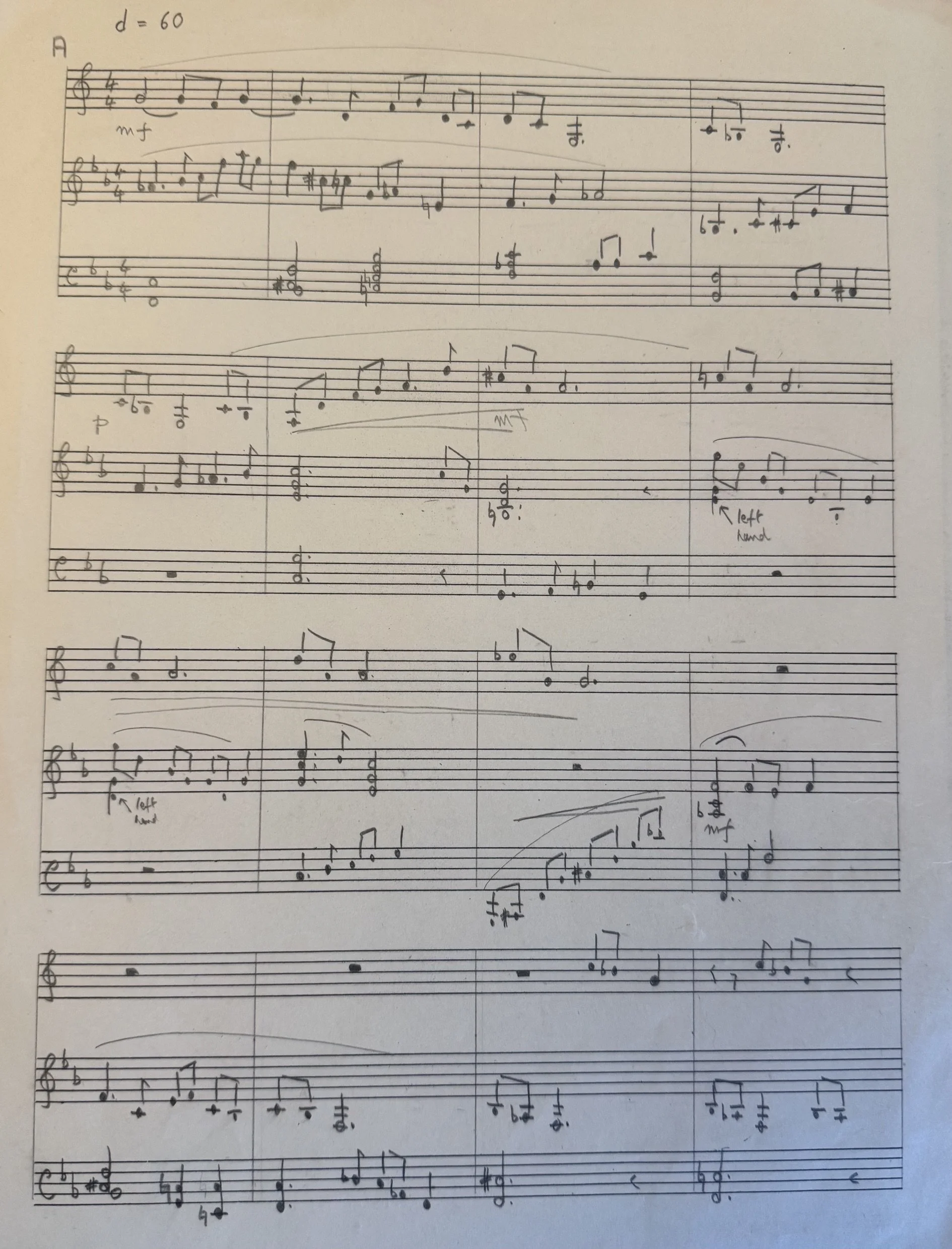
Then there was a short piece for clarinet and piano called Happy Melancholy which, as its name suggests, swung between quiet, sad and sonorous sounds and some joyfully happy bursts.
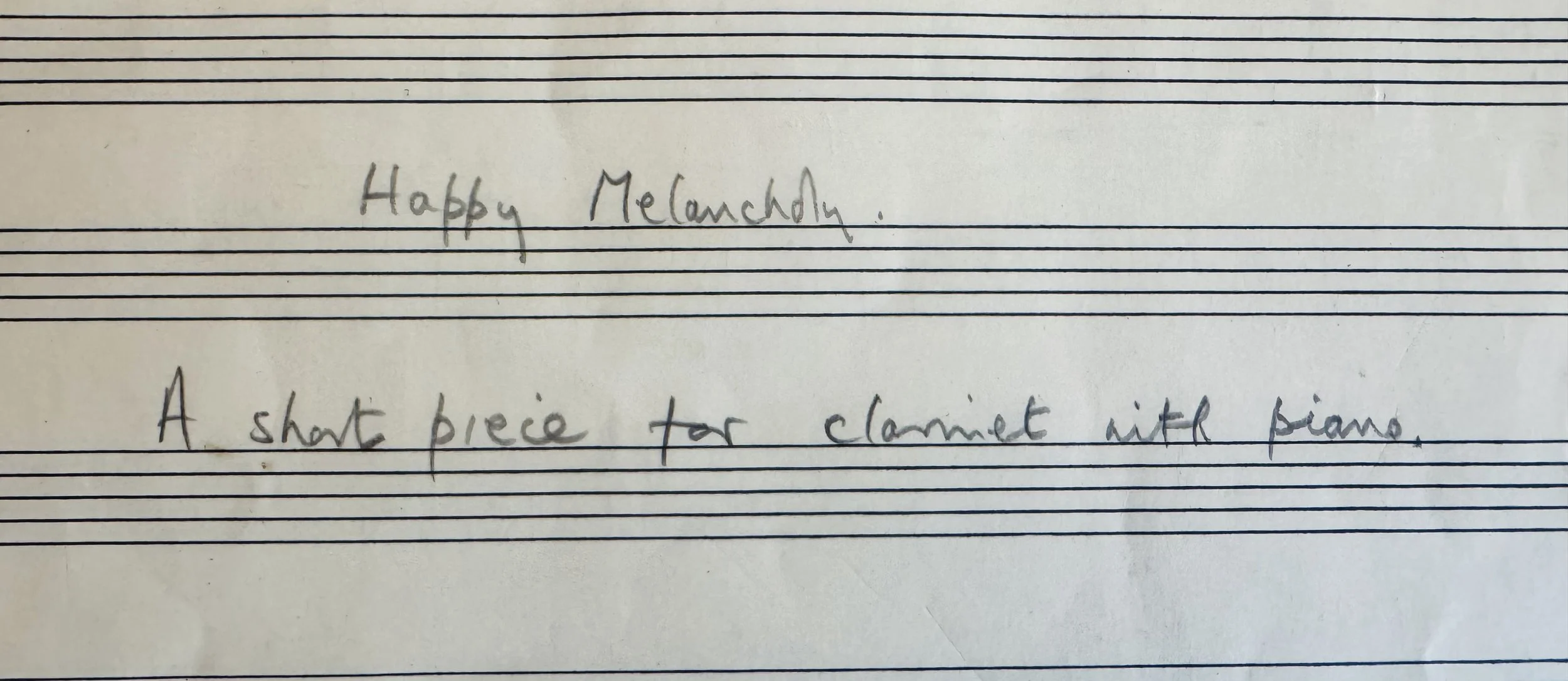
Below is the first page - the first line is clarinet and the next two lines are the piano.
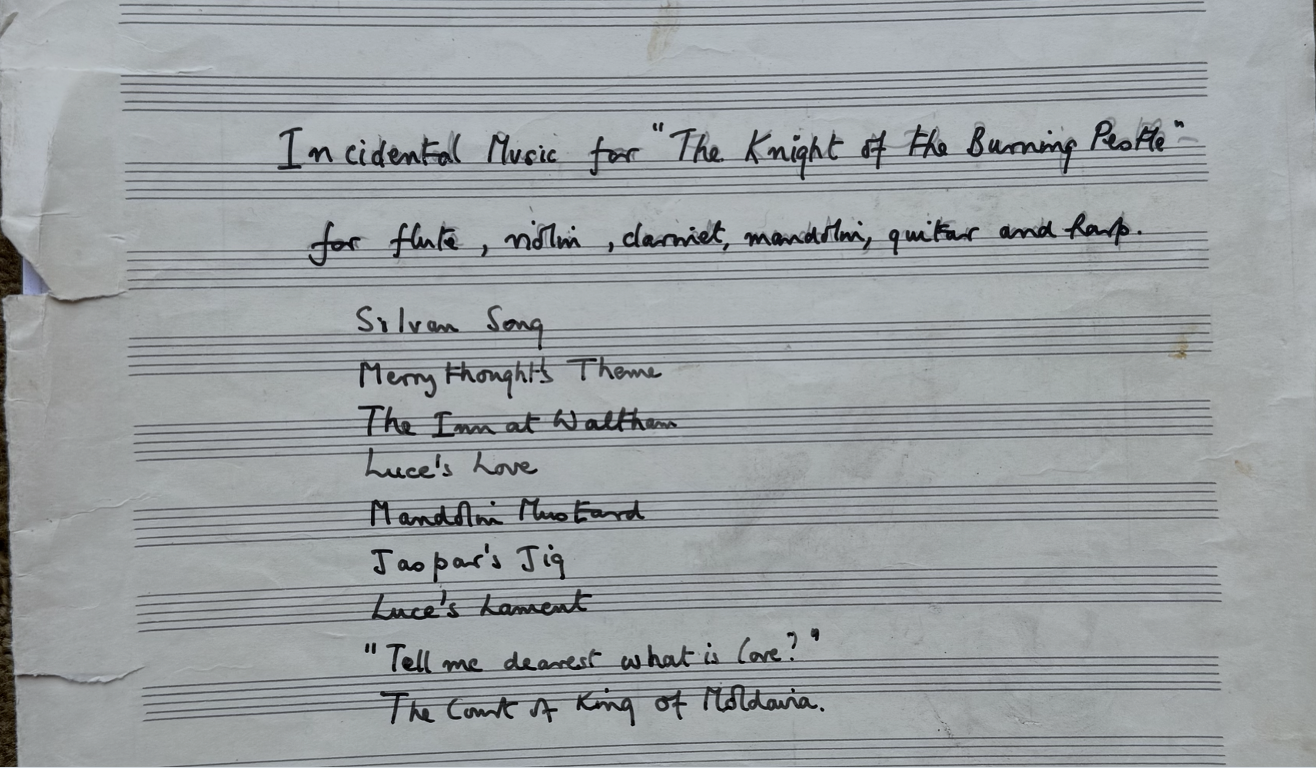
When the College Drama Society produced The Knight of the Burning Pestle I wrote some incidental music that was played live by a small trio - suitably attired in contemporary dress including knickerbockers - consisting of flute (Sue), clarinet (me) and mandolin (Pete Wright).
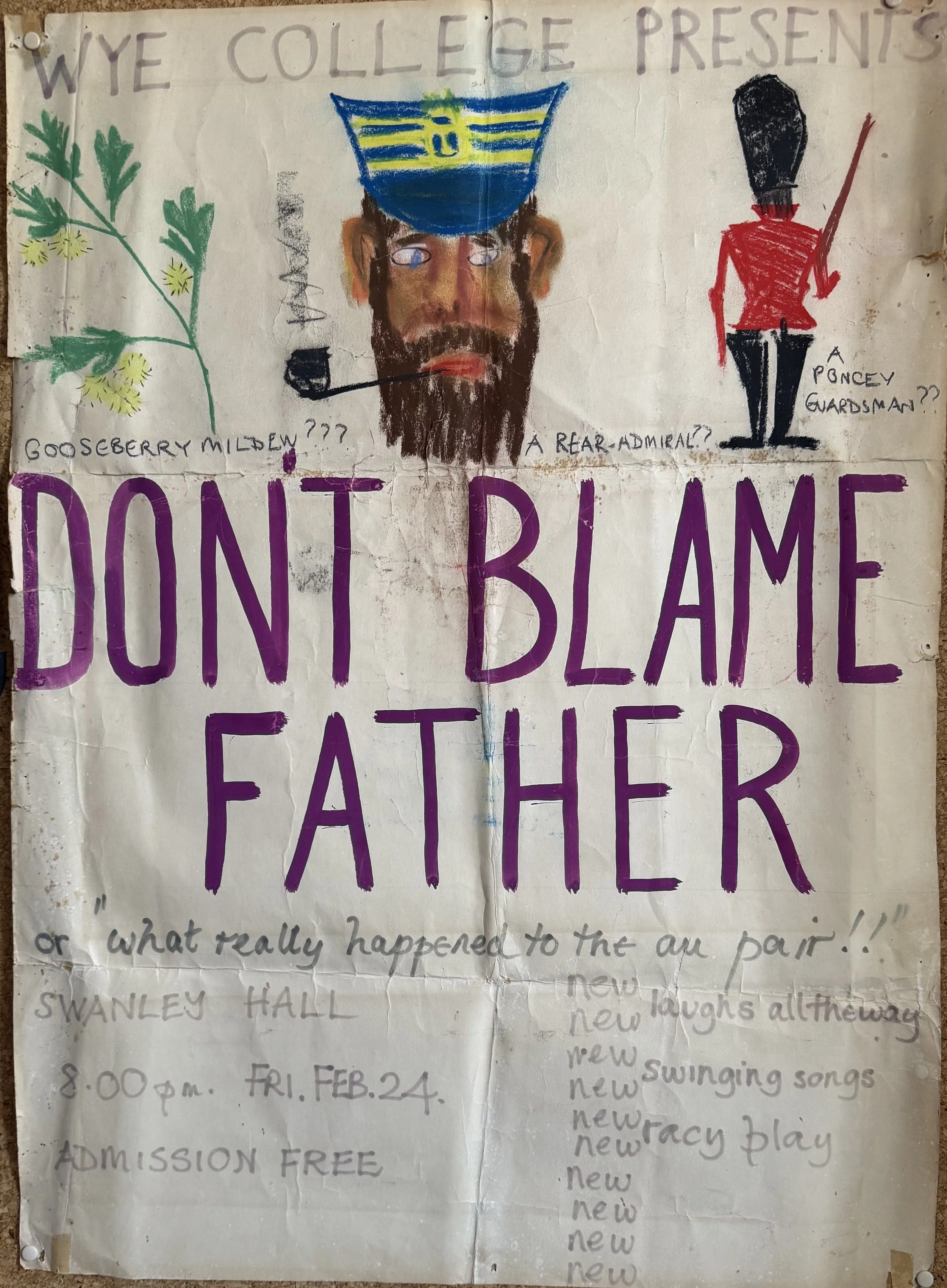
In contrast, Don’t Blame Father is a full-length musical comedy, about which more in the box below. Suffice to say here that the entire musical was written on a guitar in the small bedroom where I was lodging and only later given a full piano accompaniment - largely written in my room and then tested out on the piano when I had access to one. Overleaf is the poster for the performance at Wye followed by which is the text for an article that was published in AGRICOLA in 2022, the annual journal of the Wye College alumni, together with a couple of the photos.
DON’T BLAME FATHER. In the early 1960s the north-south divide was very real. When studying agriculture at Newcastle upon Tyne I wanted to do a special study on peas. I had to get the permission of the Senior Tutor because peas grew south of the Humber. And when I wanted to do the same with hops, I had to get the permission of Prof. Cooper - because hops grew south of the Trent! Until I arrived at Wye I had, with the exception of three primary school years spent in Bristol, always lived north of the Trent – in Hull, Leeds and the Peak District - as my father, an itinerant minister, moved from circuit to circuit amongst communities that were plain speaking and generous and who lived largely at the margin.
After the rows of back-to-back houses in Newcastle, it came as something of a culture shock to arrive at Wye – in a rolling landscape that northerners might call “nesh” and to find that the Principal rode to hounds. Not being particularly clubbable by nature, and having at school lost myself in the world of music rather than sport, I was probably something of a loner. I focused on my research work and in due course got involved in the Folk Club and then rekindled the college orchestra, which I conducted and where the first violin was none other than my academic supervisor, Prof. Graham Milbourn. When the college produced The Knight of the Burning Pestle I wrote some fairly simple incidental music (with Sue Cook on flute, Pete Wright on mandolin and me on clarinet) and then started writing some nonsense songs for the Folk Club such as Why the Peanut has a complex, The Mushroom Rock and Roll and Windy Wye.
From somewhere - probably when spending endless hours mindlessly measuring the leaf area index of tens of square feet of pea leaves using an airflow planimeter, counting the number of pods and the number of peas in each pod as well as the tenderness of those peas (using the aptly named Tenderometer) - came the idea of writing some light-hearted songs that would reflect the culture shock that I felt when I arrived at Wye. And as I wrote them it morphed into the idea of a full-length musical. It was Romeo and Juliet and West Side Story, in that two young people from very different backgrounds fall in love, but Gilbert and Sullivan in that it had both an element of the absurd and a happy ending.
At the time I was lodging in a tiny room in a small house called Roselawn in Cherry Gardens, which led up to the playing fields. My landlady was the delightful Miss Wickins, who must have been well into her 70s. I remember giving her a lift to Devon one Christmas in my A35 van, grinding for hour after hour in the snow along the A272. With no heater in the vehicle, she huddled in the passenger seat under rugs, clutching a hot water bottle for as long as it eked out some warmth and whilst I routinely stopped to clear the windscreen of snow.
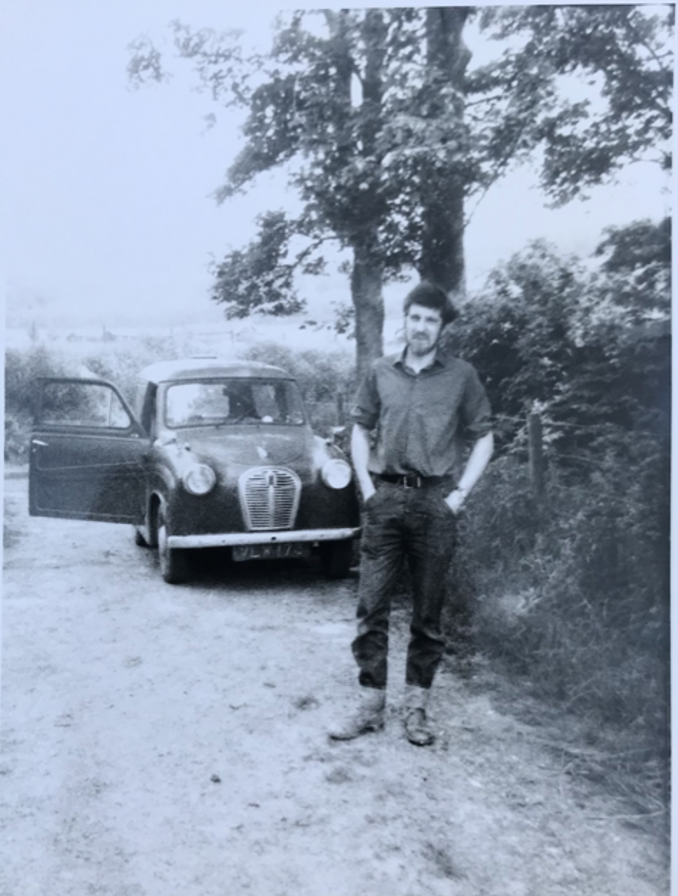
By the A35 van at Wye
My room contained a narrow bed, a small table and chair (that looked out through the curtained window onto the lane) and my guitar. I realise now that I must have written the original version of the music entirely on the guitar, although on the stage the songs were accompanied by a piano (played by Andrew Simpson with Pete Bowles on drums). I am sure that there must have been a plan as to how the story would unfold, but in practice I would write some text and then a song – after which I would go downstairs and sing it to the patient Miss Wickins - who would smile and give me her approval (or not) and the confidence to move forward. Eventually the pieces fell into place, and I could start writing the score for the piano accompaniment.
Perhaps not surprisingly it starts in an agricultural college. David (whose father is a refuse collector in Wigan played by the Folk Club’s Chris Baines) falls in love with Angela (played by Faith Shirley and who was supported by a chorus of her fellow students Libby Orton and Meg Crosse). She is the well-spoken daughter of Rear-Admiral Blossom (played by Tony Moody) and Lady Blossom (played by Shirley Colledge). The action quickly moves from the college to Blossom Towers to which David has been invited by Angela, much to her mother’s chagrin and her father’s apoplexy. Other characters that emerge and muddy the waters are the butler (played by Ceirwyn James), the intoxicating French maid (played by Mary Lawrence) and Angela’s rather effete brother Charles (played by Keith Lingard) who is in the Coldstream Guards and who grooms his busby. There are many ups and downs in the Rubik’s Cube of relationships, but in the end love conquers all and her father loudly and tonelessly leads the closing chorus with the title song - Don’t Blame Father!
There were two performances to a packed house in Wye’s Withersdane Hall on 23/24 February 1967. You can hear a rather rusty recording of the songs (originally recorded on a spool tape and then transferred to a cassette and then digitised) which you should find at https://bit.ly/DBF-recording. Because it is not always easy to hear the lyrics they can be found at https://bit.ly/DBF-lyrics. Amongst the laughter, contemporaries might recognise that of a couple of people sitting nearest to the tape recorder. I have also put the script of the closing scene – the denouement - on a pdf, which you will find at https://bit.ly/DBF-closingscene.
For those with whom I am still in contact at Wye it seems that it is for my music, as well as my concern for the overseas students, that I am remembered rather than for my studies on the social life (crop physiology) of peas.
TO AFRICA AND BEYOND. September 1968 found me at London Heathrow airport bound for Uganda, the first step on my journey to Swaziland. I had with me my trusty but heavy pseudo-leather, orangey-brown suitcase with brass locks, which in those days had a steel frame and no wheels, together with my guitar in a soft leather case made for me by my mother. The journey is described elsewhere but early one morning I found myself at Entebbe airport having arrived for a flight to Kenya that apparently “left early” - leaving me with several hours to pass before the next flight. The guitar saved the day as I strummed it to amuse myself and, in due course, to entertain and engage in conversation with other passengers who were passing by.
Once ensconced in my house at the college in Swaziland the clarinet lacked the company it needed. Having arrived the day after independence, the staff of the college were mainly from the UK or the US with a significant quota of volunteers from the UK (VSO and IVS) and from the US (Peace Corps). Over the first Christmas holiday a couple of them were planning to go to Durban and I decided to join them, providing them with the transport that they lacked. Whilst they stayed on in Durban, I continued on in my three-seater Toyota bakkie (pick-up) along the Garden Route to Cape Town where I stayed with Judy (a former girl-friend of the one of the college staff) and her Mum. She was an excellent pianist, of concert standard, and she encouraged me to go to the piano shop in Cape Town in case I wanted to purchase one and take if back to Swaziland. In the shop she started playing Grieg’s piano concerto and before long I found myself entering into a credit agreement for a Yamaha upright piano, for which her Mum acted as guarantor, and which we found would - duly boxed - fit onto the back of my pickup.
And so I arrived with the piano at the college, after driving for 20 hours through the Karoo desert and sleeping in the pickup overnight - a journey of some 1,050 miles. Once offloaded, despite the significant temperature difference in desert temperature - the piano was perfectly in tune!
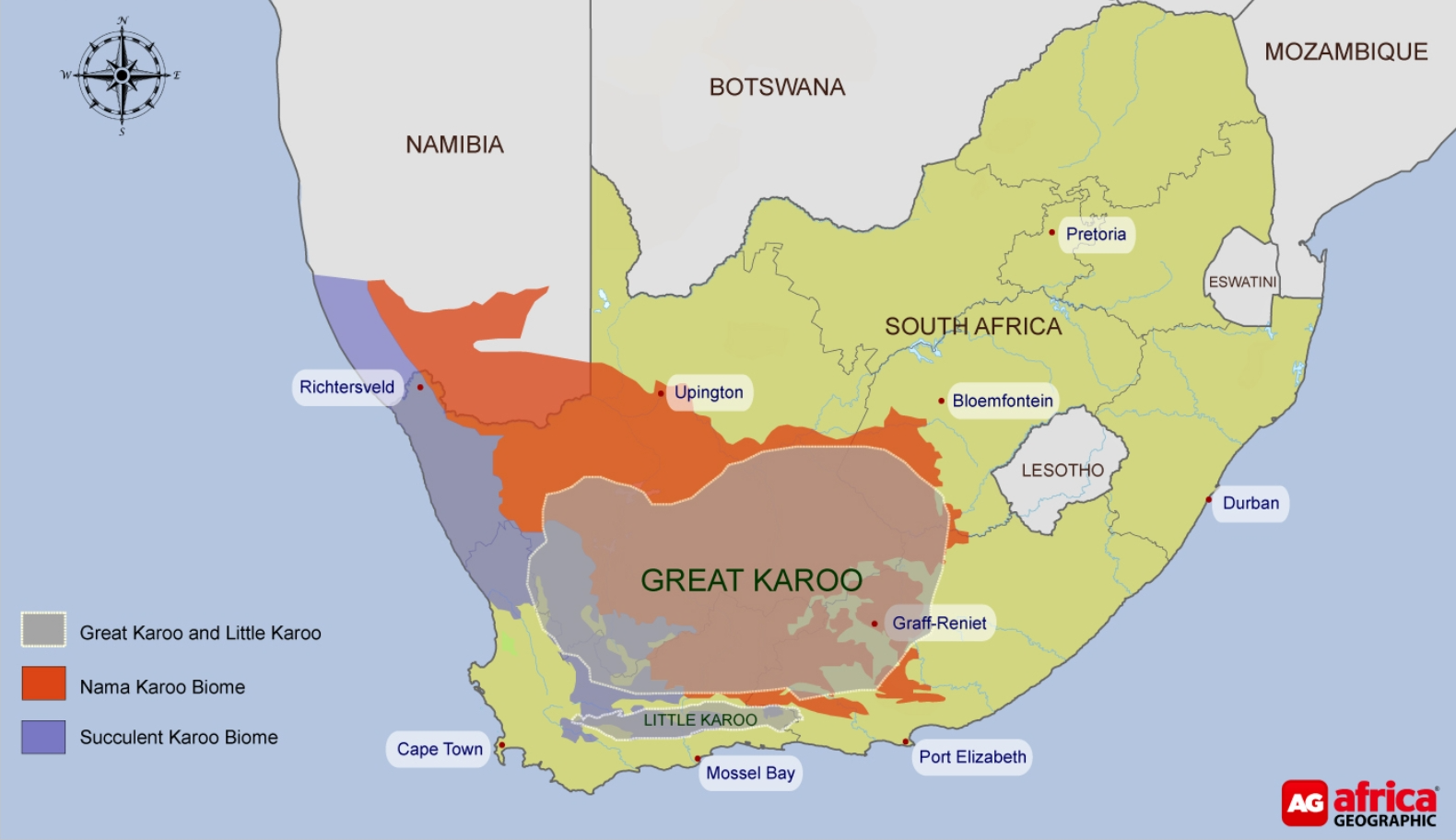
From Cape Town to Swaziland - now Eswatini
The news of the arrival of the piano swiftly circulated amongst the expatriate community and reached the ears of the British High Commissioner. It was not long before I received a request from him to borrow the piano for a concert in the capital, Mbabane, organised by the British Council. This required me to load the piano - exposed to the elements - onto the back of the pickup and drive it the 25 miles to the Theatre Club where it was to be played. This happened on more than one occasion and I still have one of the letters of thanks from the High Commissioner.
Whilst the clarinet emerged from time to time for various concerts in the college hall, together with the guitar, it was the piano around which my musical activities continued. On one occasion I was asked to play for the wedding of a student from Botswana. He was one of the older of their contingent, the one who - when we were about to leave for a trip into the Kalahari desert - asked if we had an adequate supply of tea bags!
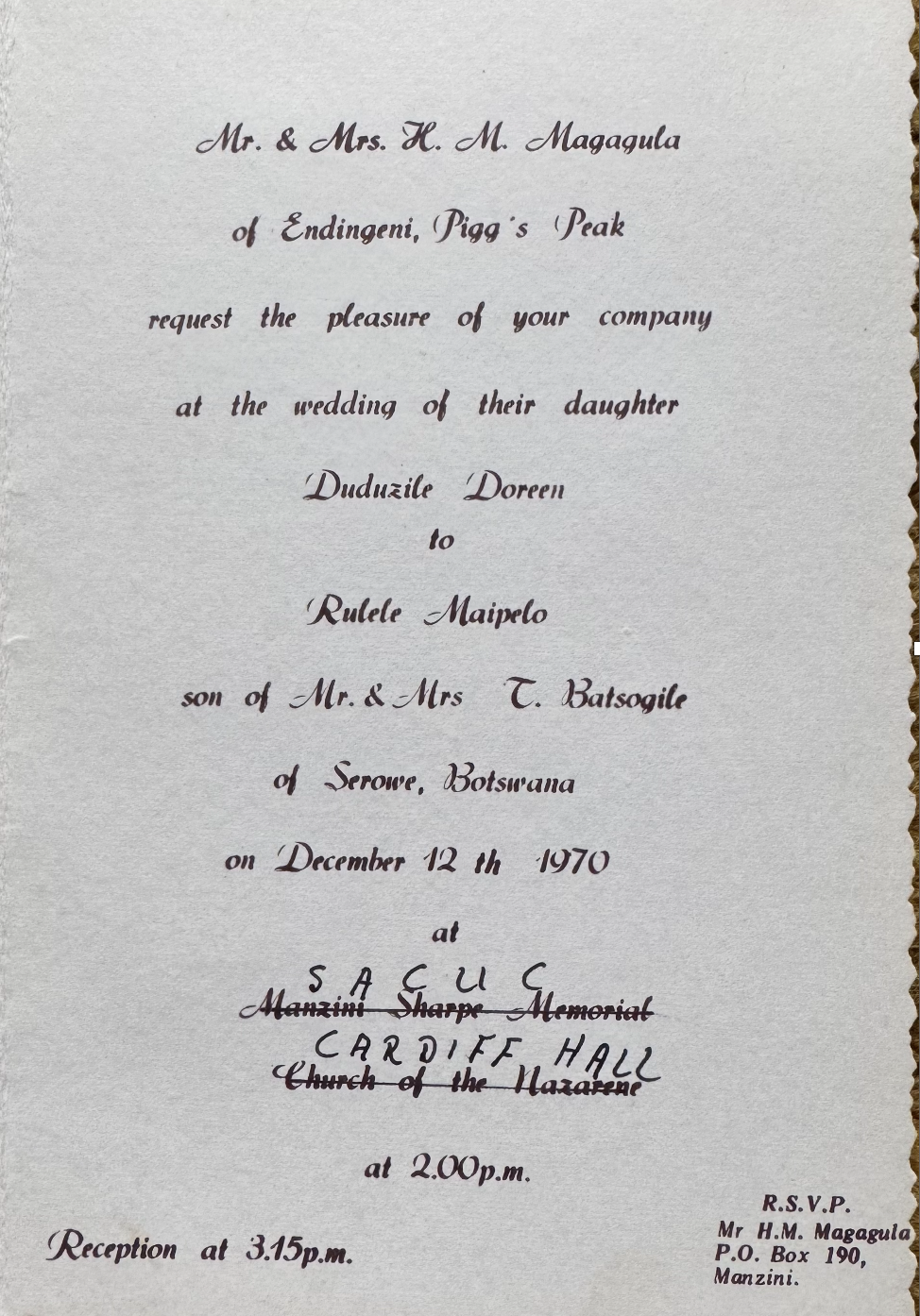
The wedding took place in the college hall, where Leline - my neighbour whose husband (Laverne) was a USAID-funded lecturer in animal science - had arranged a delicate arrangement of candles. The wedding was due to start at 2pm, at which point all the expatriate guests were present in the subtropical heat. I started playing. After some 20 minutes or so there was no sign of the couple nor of any of the Swazi guests and I was running out of music. At the same time the candles were beginning to wilt and bend in the heat. I started playing my routine a second time - only on this occasion at half speed - whilst Leline made regular trips to the front to straighten the candles. It was around 3pm when the couple and their Swazi guests eventually arrived, by which time I was running out of music for a second time and the candles had already spluttered out.
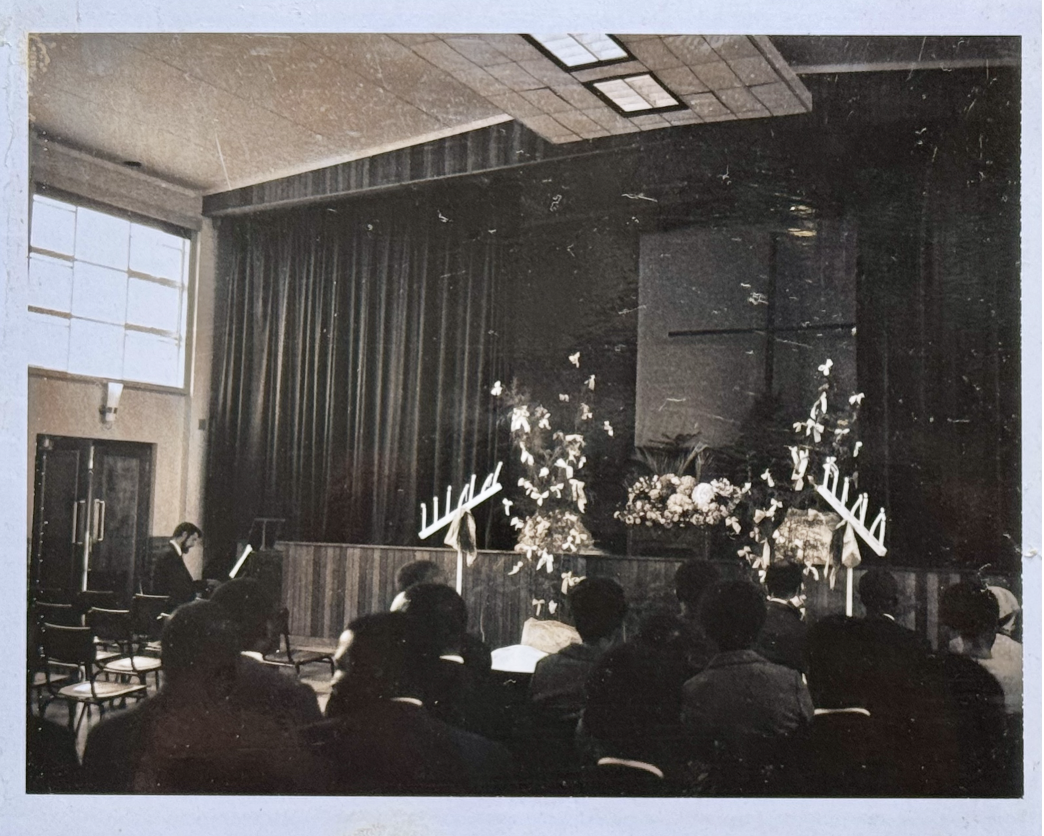
The couple were duly married. Leline and I took away many lessons learnt!
To the Theatre Club. At least a couple of times a week I would climb into my pickup and head for Mbabane, frequently calling in at the Theatre Club. It was, indeed, a small theatre with a bar where people met - mainly expats but also some of the Swazis who had an interest in the theatre. There was always a play or a musical in rehearsal and I joined in at least one of the musicals. At some point I must have mentioned Don’t Blame Father because they asked if they could perform it. Somewhat bemused I agreed to the proposition and started writing some more music for a chorus that would permit more people to be on stage.
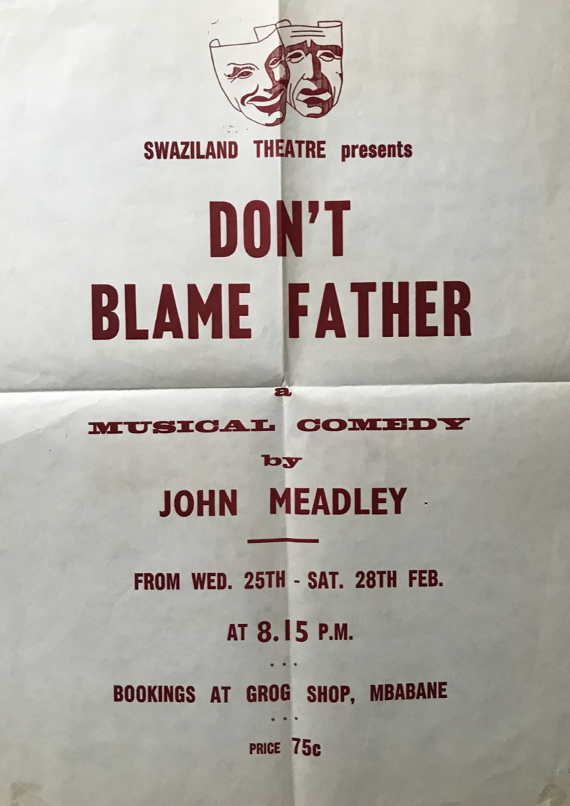
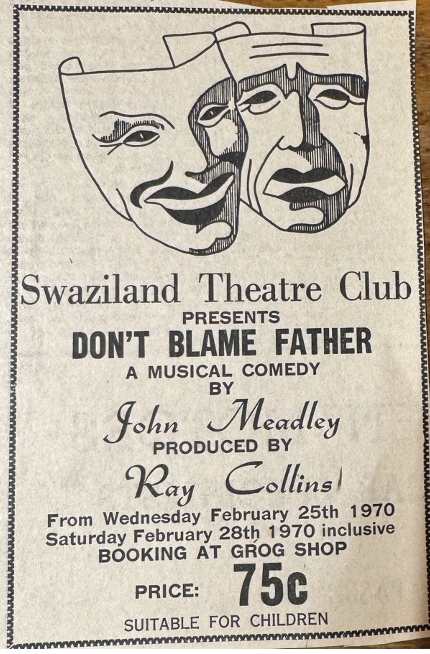
Advert in the Times of Swaziland
I ended up playing David – the male lead role. It ran for four nights.
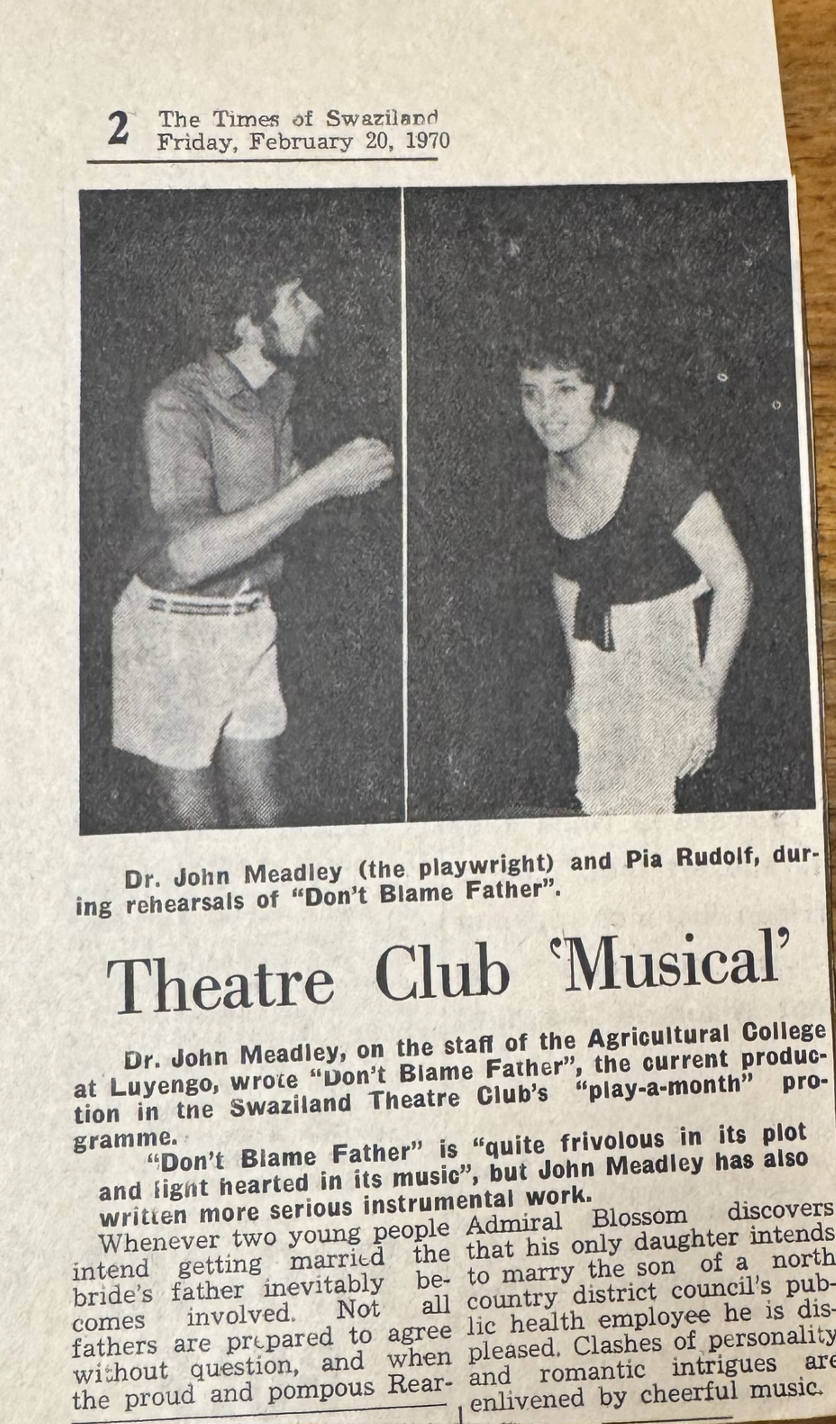
. Review in the Times of Swaziland
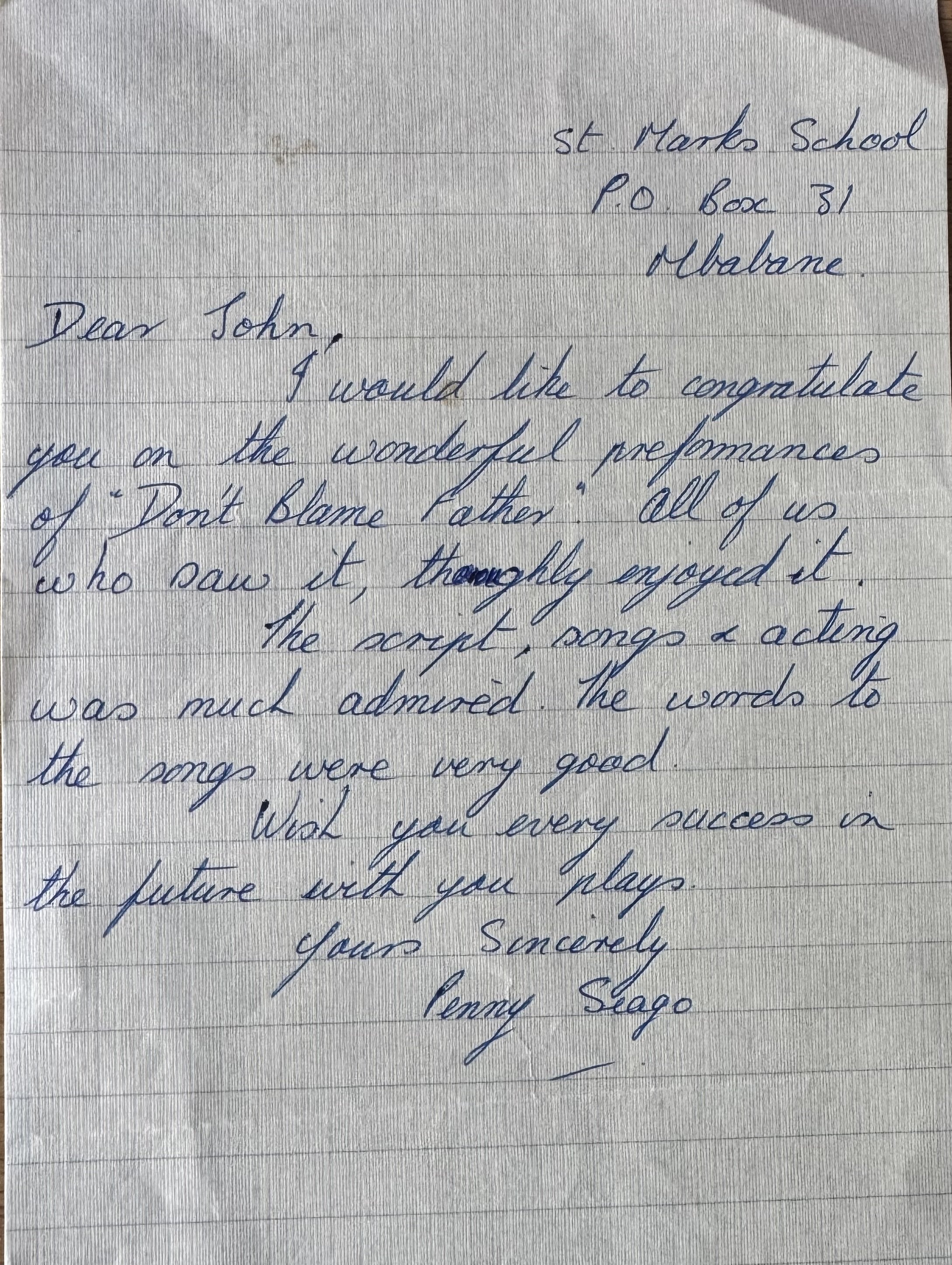
Letter from Penny Seago, daughter of John Seago who was lecturer in animal production at SACUC.
Given that this was a musical about the extremes of social class in the UK, and that it was being performed in the capital of an African country that had only become independent two year’s previously, its success in Mbabane was something of an enigma. Perhaps writing some more music so that more people could play musical instruments and be on stage did the trick - or perhaps the issue of social difference - be it class or tribalism - is simply universal and it touched a chord.
A LECTURE ON MUSIC. Rifling through a pile of old papers I came across a letter on SACUC-headed notepaper dated 29th January 1970, some 17 months after I had arrived in the country. You can read it here – an invitation to give a short talk to the students on “The Origin and Development of Music”.
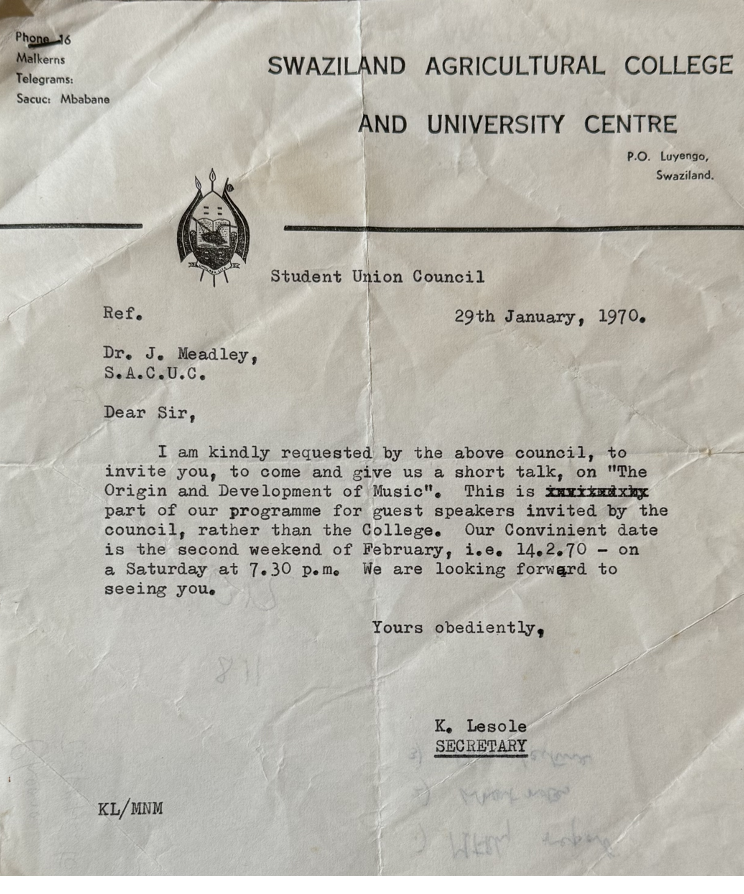
For this to happen I must somehow have given the impression that I knew something about the subject – perhaps because I was the only person on the campus with a piano. I have little recollection of delivering the talk but attached to the letter were copious, hand-written notes – not all of which are legible - from which I must have delivered the talk. Because there are many references to specific pieces of music to illustrate the points it looks as if I was able to play the various pieces so that they could hear them – although access to a record player or a tape recorder seems unlikely some 54 years before I am writing this. I have done my best to untangle the notes and you will find them in the Annex. I was 27 at the time and reading through the notes I get a sense of how I was thinking at the time and what kind of music was influencing me - in particular my starting with reference to water and to Smetna’s Moldau - also known as Ma Vlast (My Country) – the symphonic poems about the River Vltava which rises high in the forests of Czechoslovakia (as then named) and flows through Prague to the sea.
On leaving Swaziland in 1972 I was ill-advised that my piano had been adapted for sub-tropical conditions and would not perform well in the UK - so it stayed behind. I returned only with my clarinet and guitar and it was some years before there was a piano in the house. It was only occasionally that either the guitar or clarinet would accompany me on one of my many trips overseas. The clarinet needed other instruments around it to make music whilst the guitar took up space.
Whilst having a guitar to hand opened lots of doors, there was one particular incident - and probably the last significant public one - in which it not only opened doors but had some diplomatic significance. The story is told in full here but in brief in 1994 I was with a group of British businessmen on a rice barge on the Chao Phraya River being entertained for dinner by the Thai Deputy Minister of Agriculture in the presence of the British Ambassador. There was a Filipino band playing at one end. The Minister exceeded his alcohol limit and, after spontaneously singing a couple of songs backed by the competent Filipino group, slapped the Ambassador on the back and challenged him to do the same. There was a stunned silence. Wisely or otherwise, I pushed back my chair and asked to borrow one of the guitars before starting to sing “It’s a lesson too late for the learning, made of sand, made of sand” - encouraging the band to pick up the chords and back me - which they did. There were whistles and loud applause when I sat down and - as the ambassador advised me later - “I had saved the flag and a diplomatic incident had been avoided!”.
Thereafter the piano kept me amused and capable of accompanying those wishing to sing carols at Christmas – or to hear a rendering of “Why a peanut has a complex” or nostalgic renderings of some of the songs from Don’t Blame Father. Meanwhile the clarinet had occasional outings, sometimes significant, and particularly around the playing of Stranger on the Shore – a piece written by Acker Bilk for his daughter Jenny and first released in 1961 – becoming number one in the US and UK charts. This was shortly after I had left Kingswood, although I was familiar with the name Acker Bilk as he used to play in the Pump room and was a friend of Les Gollege. I came to love the piece, as did my mother who would frequently ask me to play it for her – so it was particularly appropriate that I should have the opportunity to play it at her funeral in Bethesda Methodist Church in Cheltenham accompanied by Tom on the keyboard. Another occasion that Tom and I played it was a couple of years later when Fiona and I celebrated our joint 140th birthday in 2012 which we held in the garden. I remember playing it in the evening sunshine, looking up the garden with Tom beside me on keyboard and saying that we were playing it in memory of my mother and other absent friends – thinking particularly of our friend Dave Nicol, who had recently died, and conscious that Clare was amongst those present.
It was around that time that Tom had been invited to join Jazz Friday, a small group of older men who played jazz on a Friday evening in a hall in Rodborough. The two key organisers were Ian Davies and John Oglethorpe whilst the group was conducted by Nathan King - a peripatetic music teacher. We used to drop Tom off at the hall and pick him up afterwards and it was clear that Tom not only enjoyed it but was growing in confidence. The members of the band were both welcoming and encouraging and appreciated his nascent and growing skills as a jazz musician.
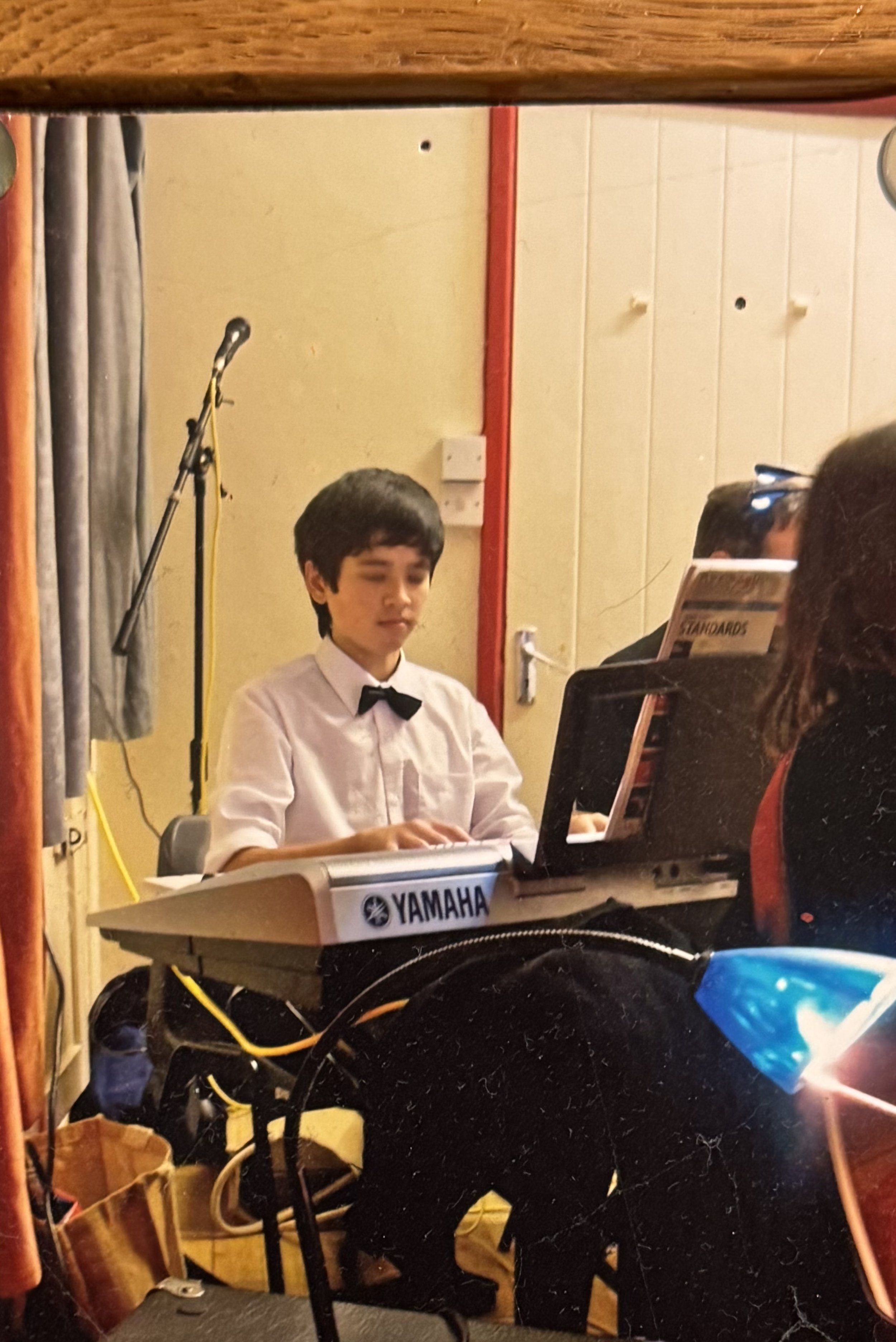
Tom in his very early days with Jazz Friday
For some time they, and Tom, encouraged me to join the band with my clarinet but I lacked the confidence both to play generically but particularly to play jazz – which was a new medium for me. Eventually I gave in and gradually grew in confidence – although right to the end I lacked the skills to extemporise and allow the music to flow naturally and freely when given my 8 or 16 bars. This was in complete contrast to Tom who both looked forward to the opportunity and excelled in it.
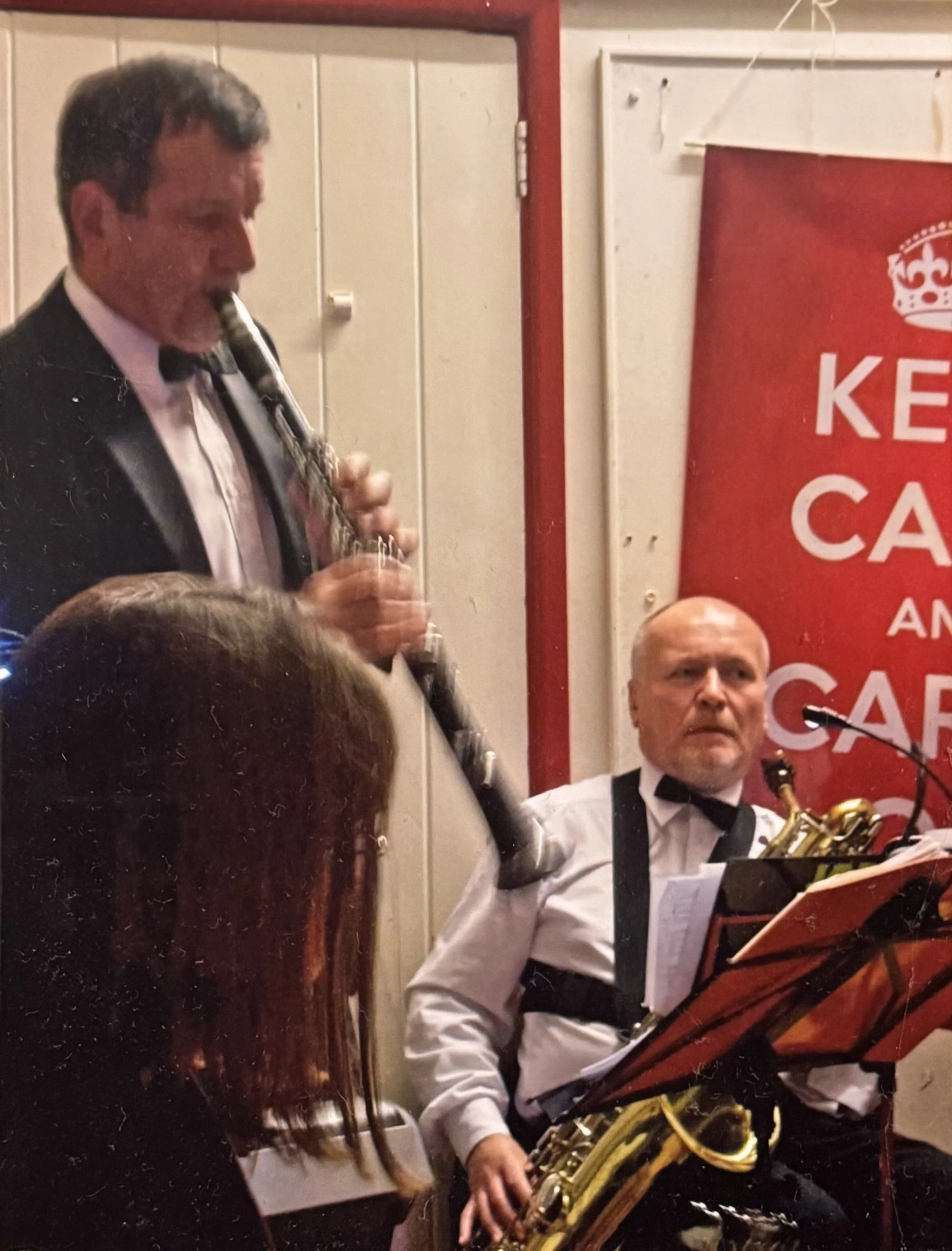
Sometime later they asked him to write something – two pieces called Matumbe and Grey Clouds – and which we played on several occasions including in the bandstand at Stratford Park in Stroud. They were great pieces but quite, quite complicated for the players and there was a request that next time perhaps he could write something simpler! Apart from the music it was a wonderful opportunity for me to spend time with Tom in an activity that we both loved – and to have the time to talk as we drove over to the new location in the village hall in Brookthorpe. It had something of the feel that Fiona must have had when she and Tom went each week over the years to train in karate in Quedgeley. We continued playing there until Tom left school.
Once Tom had moved on the inspiration diminished for playing an instrument that needs company and over time there was an incipient reduction in the flexibility of my hands as some sort of arthritis set in – which constrained my capacity to play both the clarinet and the guitar to the point where now I cannot play the clarinet with any skill or joy and my fingers are less fluid on the piano keys. But I still have the joy of listening to Tom as he continues to express his ideas and experience in words and in music and when weaved exquisitely together.
ANNEX ONE. THE ORIGINS AND DEVELOPMENT OF MUSIC – NOTES FOR A TALK TO THE STUDENTS OF SWAZILAND AGRICULTURAL COLLEGE ON 14TH FEBRUARY 1970[1]
Two ways that we can express ourselves are through WORDS and MUSIC. We can do this either as a way of describing something (as in non-fiction) or of expressing emotions (as in fiction).
MUSIC is the arrangement of sound to create some combination of form, harmony, melody, rhythm or otherwise expressive content. The sounds can come from many different sources and may be heard alone (in solo) or together.
The voice is the sound produced in a person's larynx and uttered through the mouth, as speech or song. Varying in pitch, range and tone depending upon many characteristics including the gender of the singer – from bass through tenor and contralto/alto to soprano/treble and falsetto.
Percussion is the striking of one solid object with or against another with some degree of force. Normally made of wood or skin (or a combination of both) which is hit by an object, the end of which is made of metal, fur or wood. The sound coming from it depends upon the materials used, its size and the intensity with which it is hit.
Stringed instruments produce their sound by the vibration of stretched strings, which may be made of vegetable fibre, metal, animal gut, silk or artificial material such as nylon. The string may be plucked, struck, rubbed or bowed to make the string to vibrate. In most cases the sound of the vibrating string is amplified by a resonating chamber or soundboard. Examples include the Guitar (made of wood with nylon or steel strings played with fingers or a plectrum); the Violin family (made of wood with gut strings played with horsehair); and the Banjo (made of wood and skin with steel strings played with a plectrum). The piano is a stringed instrument in which the sound is made by felted hammers hitting the steel strings.
Wind instruments produce their sound by air vibrating/resonating within a tube – the nature of the sound depending upon the type of mouthpiece and the length of the tube (which may be determined by opening or closing holes in the tube). They are made of metal (tin whistle, horn, trumpet and euphonium) or of wood (the recorder, the clarinet, oboe, flute and bassoon).
Pitch – whether sounds are high or low – is determined by the frequency of the wavelength, generally determined by the length or volume of what creates the resonance. E.g. the length of the tube in wind instruments or of the string in stringed instruments or the volume of the drum.
A scale is a succession of rising or falling pitches with the same interval between the notes.
[1] In order to make the notes a bit more readable I have occasionally added in definition to make things more understandable or interesting and even possibly to provide something that generates interest in exploring the topics further.
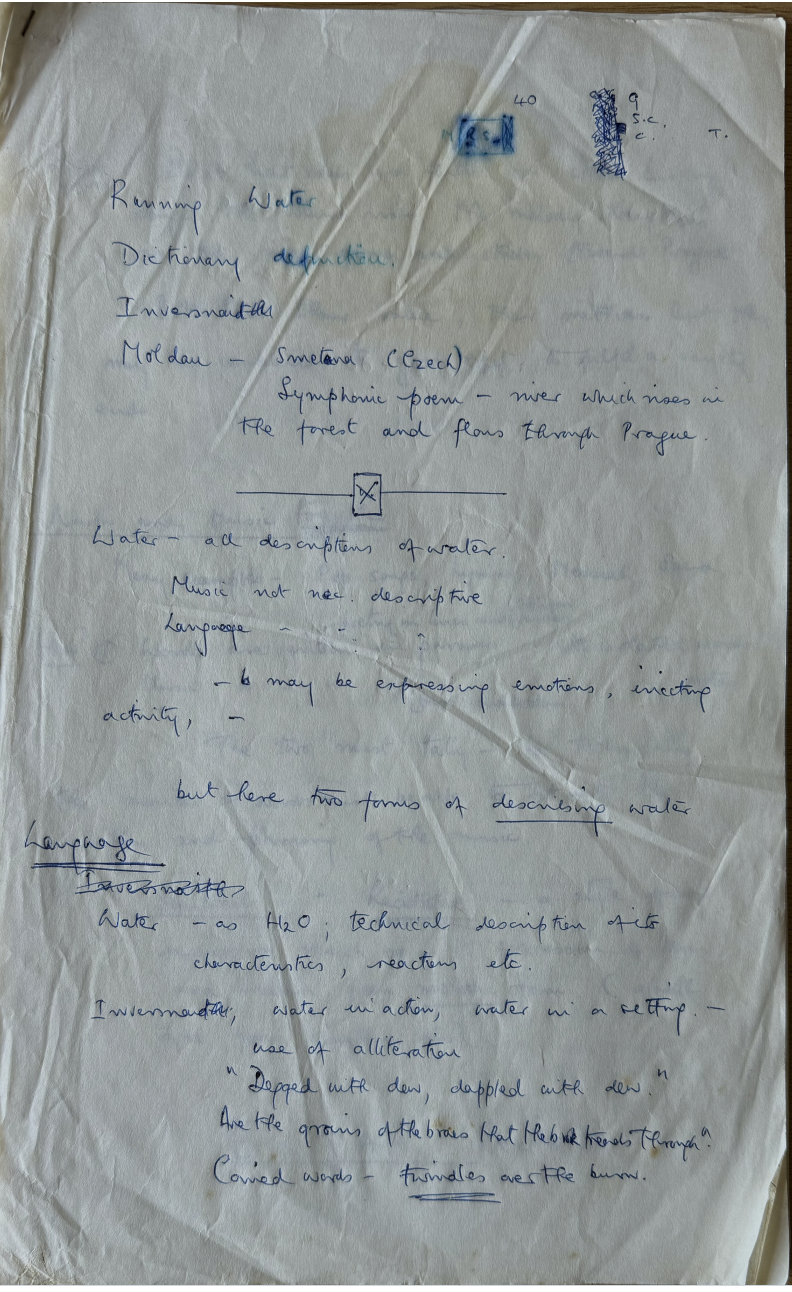
The first of a dozen pages of hand-written notes for the talk
A chord is a group of notes played simultaneously. The difference between a major chord/scale (brighter and cheerier) and a minor chord/scale (darker and sadder) is that in a minor chord/scale the third note is flattened. A key is a series of pitches in sequence that starts from a particular note. An arpeggio is a type of broken chord in which the notes that compose a chord are individually sounded in a progressive rising or descending order. A melody is a succession of pitches that may appear on its own or be supported by other pitches to produce a harmony.
Rhythm is a strong, regular repeated pattern of movement or sound. This may vary from the regular of 4/4 time (four beats in a bar) in which all beats may be given equal emphasis (such as in Living Doll) or only one of the beats may be emphasised (e.g. Cha Cha Cha). Three regular beats in a bar gives the waltz. 5/4 time gives an odd and uneven rhythm as is found in Take Five.
All these elements – the voice, stringed and wind instruments, percussion, pitch, melody, rhythm, volume and speed - combine in endless combinations to produce music, which may occur on its own or together with words.
MUSIC AND WORDS.
Starting with WORDS we can describe water as “an inorganic compound with the chemical formula H2O. It is a transparent, tasteless, odourless,[c] and nearly colourless chemical substance. It is the main constituent of the Earth’s Hydrosphere and of the fluids of all known living organisms”. On the other hand, in the poem Inversnaid Gerald Manley Hopkins describes the fast-flowing stream with magnificent use of alliteration….
Degged with dew, dappled with dew
Are the groins of the braes that the beck treads through…….
…and uses words like “twindle”[1], which cannot be found in the Oxford Dictionary and yet we immediately know what he means.
Turning to MUSIC in Smetana’s Ma Vlast Second Symphonic Poem (The Moldau) we can find a wonderful, descriptive picture of the River Vltava in former Czechoslovakia, with light violins and flutes describing the stream as it rises gurgling in the forest before flowing with increasing strength and majesty down to Prague.
Within this music we can sense the different instruments and the elements of melody, pitch, rhythm, major and minor keys, volume and speed. For example, flutes and violins are used in the early stages of The Moldau to describe the bubbling stream and the use of trumpets in the Hallelujah Chorus to describe the jubilant celebration.
[1] He used other such words – some of them seemingly made up by him – for which we know what he means despite there not being a formal definition. See here.

The River Vltava (as known as the Moldau in German) flowing through Prague
There are endless other examples of musical forms including those formed of small groups (e.g. Schubert’s Trout Quintet), the symphony (instruments brought together in an orchestra where no particular instrument is dominant – for example Beethoven’s Pastoral Symphony) and the Concerto (played by an orchestra where one instrument is dominant – be it piano, violin, trumpet, cello or many others – of which there are so many examples including Elgar’s Cello Concerto, Mozart’s Clarinet Concerto or Tchaikovsky’s Piano Concerto No 1.
WORDS AND MUSIC can also be brought together – as in songs, hymns and opera. Neither words nor music are written in isolation but in phrases where the words and music must tally and fit into the rhythm and phrasing of the music. This relationship between words and music extends from the very basic to the most complex. Some examples of this are given below.
Recitative. This is a style that resembles speech but is associated with a series of tones and is free from any melodic form (and generally free from any rhythm). Find an example here, leading in to a choral section. I am not sure if this would formally be considered a recitative but to me Rex Harrison’s rendering of “Why can’t a woman be more like a man?”, where he is simply talking to the music, has all the hallmarks of one.
An aside on rhythm and melody and other tools. There is often a direct relationship between words, melody and rhythm. It can be found at its most basic in “The modern major general” in HMS Pinafore. The simple melody and the tight military rhythm help to create the image of the major general with the music helping the flow of the words. In the world of language our tools are words, the choice and succession of words and the use of rhyme, rhythm and alliteration. In poetry we may have fixed forms within which the words must fit – such as the ode or the sonnet and at the other extreme the free form of the Liverpool poets.
In the world of music our basic tools are melody, rhythm, the key (in either its major or minor form), harmony (the combination of different notes), the use of different instruments, the tempo (speed) and the volume. Basic to all of this is the scale, which is a series of eight notes that starts at the lowest note of the instrument and is repeated up to the highest note. In the major scale, which generally gives a happier and more positive sound, there is a whole tone between each note. In a minor scale, there is only half a tone between the second and third note and between the sixth and seventh note, giving it a sadder sound. Examples will be given below.
The Madrigal. A madrigal is a medieval short lyric poem, which may (or may not) be sung unaccompanied. A good example is It was a lover and his lass, a madrigal from Shakespeare’s As You Like It sung by two pages when Touchstone and Audrey are to be married. As is clear from the words below it is a happy composition written in a major key.
It was lover and his lass
With a hey and a ho and hey nomino
The oer the green cornfield did pass
In the springtime, the only pretty ringtime
When birds do sing, hey ding a ding a ding
Sweet lovers love the Spring.
Greensleeves in contrast, mentioned in the Merry Wives of Windsor, is not strictly a madrigal but a traditional folk song. And as is clear from the words below, it is a sad song - emphasised by it being written in the minor key and sung at a slow tempo….
Alas my love you do me wrong
To cast me off discourteously
And I have loved you so long
Delighting in your company
Songs are not restricted to being poetry set to music. They may have a much stronger aim or purpose – for example to raise the emotions be it political, revolutionary, religious or protest. Such as “Where have all the flowers gone?” “We will overcome” has a simple melody, basic chords (only four) and simple words but can raise strong emotions, empower people and change legislation.
We shall overcome
We shall overcome
We shall overcome, someday
Oh, deep in my heart
I know that I do believe
We shall overcome, someday (Chorus)
We shall be alright
We shall be alright
We shall be alright, someday (Chorus)
We shall live in peace
We shall live in peace
We shall live in peace, someday (Chorus)
We are not afraid (oh Lord)
We are not afraid (oh Lord)
We are not afraid, today (Chorus)
We shall overcome (oh Lord)
We shall overcome (oh Lord)
We shall overcome, someday (Chorus)
The times they are a-changing has a simple, strong tune, simple chords, a very strong strident rhythm through which are delivered the strong lyrics.
O God our help in ages past is often quoted as one of the most reassuring and hopeful of hymns through its words based on Psalm 90. Written by Isaac Watts (who wrote several hundred other hymns) It is sung at the Service of Remembrance. But in reality it is the music composed by William Croft (the melody known as St Anne) that, combined with the words, make it such a rousing, powerful and emotive hymn.
Requiem. The word requiem comes from the opening words of the Roman Catholic Mass for the Dead, which is spoken or sung in Latin (requies means “rest”). In a nonreligious context the word refers simply to an act of remembrance. It is a set form of liturgy in religious worship and can be found in many settings. Here are two examples referring specifically to the Sanctus whose words are Holy, holy, holy, Lord God of power and might. Heaven and earth are filled with Your glory. Hosanna in the highest.
The Sanctus in Faure’s Requiem is quite ethereal. It starts and ends with a harp, later supported by strings and woodwind with the simple melody rising to a crescendo before moderating again to a thread, the harp echoing the beginning. What a difference the music makes to these simple words. Faure depended little on rhythm instead relying mainly on string arpeggios, firm melody, crescendo and diminuendo – fitting for a European cathedral made of stone signifying permanence, stone with people standing in rows.
The Sanctus in the Missa Luba (an African Mass) has the same words and expresses the same sentiments to the same God but is strong on rhythm, with drums playing throughout – fitting for singing in the open air
Popular music. Words and music come together in popular music – for entertainment and inducement to dance. The Beatles’ Eight Days a Week has a simple tune and a strong rhythm but is hardly designed to encourage you to think of heaven.
Carmina Burana is a cantata composed in 1935-6 by Carl Orff, based on 24 poems from the medieval collection Carmina Burana. Its full Latin title is Carmina Burana: Cantiones profanae cantoribus et choris cantandae comitantibus instrumentis atque imaginibus magicis. The poems consist of medieval poetry and satirical texts that mock the Catholic Church and were written in Latin and German by a group of nomadic, defrocked clergy. They comprise a series of dance songs in the wood, in the tavern and on the green – men and women dancing together and on the rampage. It is essentially dancemusic. The extraordinary words can be found here and, perhaps not surprisingly, were banned by the Nazi party.
In Opera words and music come together as drama, combining to tell a story, a dialogue to music – with individuals, couples and groups speaking and singing together.
The duet between Pamina and Papageno in The Magic Flute (Act 1, scene 2) is opera at its simplest. Note how it develops from the basic melody, each voice in turn, and then in harmony together. “The kindly voice of Mother Nature wakes love in bird and beast and flower”….. If you listen to the hymn “Behold the Servant of the Lord” being sung you will find that they have taken the tune directly from this duet and with Mozart being acknowledged as the composer. Another magnificent duet is that of the Pearl Fishers in the opera of the same name by Georges Bizet.
Modern opera. From the relatively structured operas of Mozart with strong melody, development and harmony we can move forward three centuries to the modern opera of Leonard Bernstein – West Side Story - which is an updated version of Romeo and Juliet with the lovers coming from two communities in conflict with each other …the Jets (Puerto Ricans) and the Sharks (Americans). Listen to When you’re a Jet as the Jets prepare to challenge the Sharks to a fight. It builds up a vicious atmosphere with cross rhythms, a melody in triplets (3/4 time) with backing in 4/4 time – changing all the time.
…………..and this is where the handwritten notes end…..