On 7 September 1968, I arrived in Swaziland (now Eswatini) to teach crop production at the newly established agricultural college.
It was a poignant moment as some eight years earlier I had left school with virtually no knowledge of “science” - having gone through the classical stream. In the intervening years, I gained practical experience on a farm, whilst learning about molecules and photosynthesis at night school, before undertaking undergraduate and postgraduate studies in agriculture (Newcastle) and crop physiology (Wye).
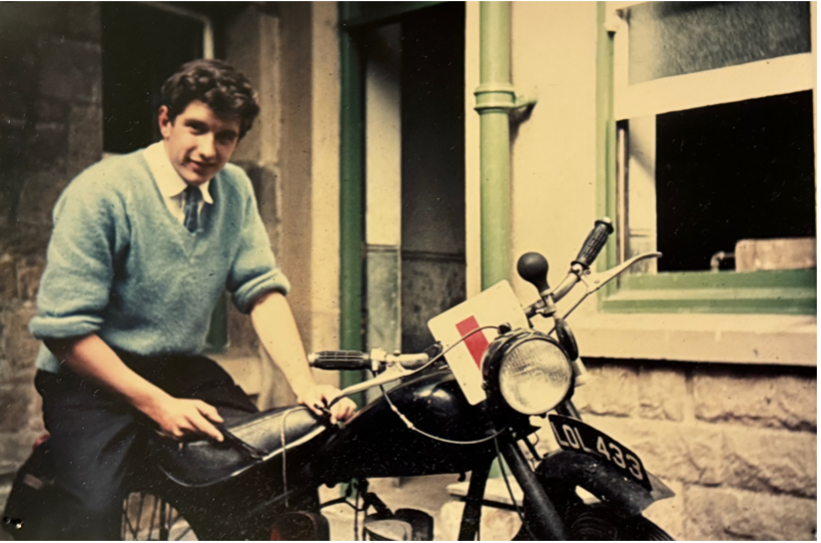
For the first couple of those learning years my main means of transport was this 1950s BSA Bantam 125cc, essentially a piece of Meccano on wheels with a very small engine and no rear suspension. It took me round the lanes of Derbyshire where we lived at the time and later up (and down) the 150 miles of the A1 to Kings College, Newcastle (then part of Durham University) with a full-sized sea-trunk strapped perilously on the back.
I left Swaziland in 1972 to join a small agricultural consulting company. My first assignment was to help develop a farm in a remote part of the French-speaking Democratic Republic of the Congo (then called Zaire). To get there involved travelling by night along potholed, gravel roads peppered with roadblocks manned by AK47-wielding men in uniform. Each of them wanted to know my purpose and check my credentials. I soon learned that politeness, an interest in their families and the offer of a biscuit or a cigarette could generally get me through unscathed. I grew up quickly.
Wearying of writing reports that mostly seemed to remain on shelves, in 1983, I set up a small company (Rural Investment Overseas Ltd – RIO) to work with entrepreneurs in Africa and Asia – as they seemed to be the people who made things happen. Remaining small and nimble, we could respond to need and opportunity as it arose. Within a year, we found ourselves addressing at national scale, the problem of aflatoxin in Thailand before setting up a joint venture to pelletise the spores of ectomycorrhiza in the Philippines. We helped to set up agricultural/development banks [i] and started two of the first venture capital companies in Africa (in Tanzania and Ghana). At the same time, I had my only brief tryst with academia, appointed as a visiting professor at Silsoe College, then part of Cranfield. Perhaps they wistfully hoped that my travels would bring in international students.
In 1999, with a son then aged three and with both Fiona and I working and travelling, we wound up RIO as a going concern so that we could continue to pursue our various interests with less pressure. Whilst Fiona established herself as a ceramic artist, I worked freelance - leading to an involvement in the rebuilding of rural life in war-torn Sierra Leone and Liberia, working with entrepreneurs and former combatants.
Then came engagement in the world of social marketing – which uses private sector skills and practices for social and economic development. Working initially with bed nets for malaria prevention, it extended into water and sanitation - including writing a module for undergraduates at the University of Mzuzu in northern Malawi on “sanitation as a business”. From 2012-16, I supported a team of Indian colleagues building a market for toilets (on the basis of willing buyer-willing seller) in the populous state of Bihar. A recent interview with the Gloucestershire Green Pledge Project will give more background.
Over the years, this work took me from rural China in the east, through SE Asia, the Indian sub-continent, the Middle East, Africa, Ukraine, the Caribbean and Central America to Bolivia in the west.
In 2009, uneasy with the intensive feeding of grain to ruminants, particularly when many of those with whom I was working were hungry, a chance meeting with two British pastoral farmers led to what is now Pasture for Life. And another chance meeting with a group of amputee footballers in Sierra Leone in 2012 led to Farming on Crutches, which trains some of the country’s many amputees to become organic farmers.
I have the good fortune to still be in daily contact with those who farm the land in Africa and Asia, as well as in the UK.
John Meadley
[i] In Ivory Coast, Tanzania, South Africa and Palestine (planned but not realised).
Video and Audio recordings
The Green Pledge @ Gloucestershire Archives
John Meadley has spent a lifetime working in agriculture and overseas development. He lives in the Stroud area and has spearheaded many local green projects. He is the co-founder of Pasture for Life, an organisation focussed on pasture fed livestock for the sake of the animal, the soil and biodiversity.
In 2012 John was voted an Environmental Hero by the Heart of Gloucestershire Community Awards.
An important part of the Green Pledge Project is collecting oral history or life story interviews. The aim of the collection is to make sure we have an archive which tells the story of what is happening in our area today. The interviews explore the work of people dedicated to bringing change, or protecting the environment, but also digs a little deeper and asks what their influences were. These longer-form interviews will be available to listen to at the archives. We've edited extracts for these podcasts.