CÔTE D’IVOIRE - “Vous avez bien pénétré l’Afrique.”
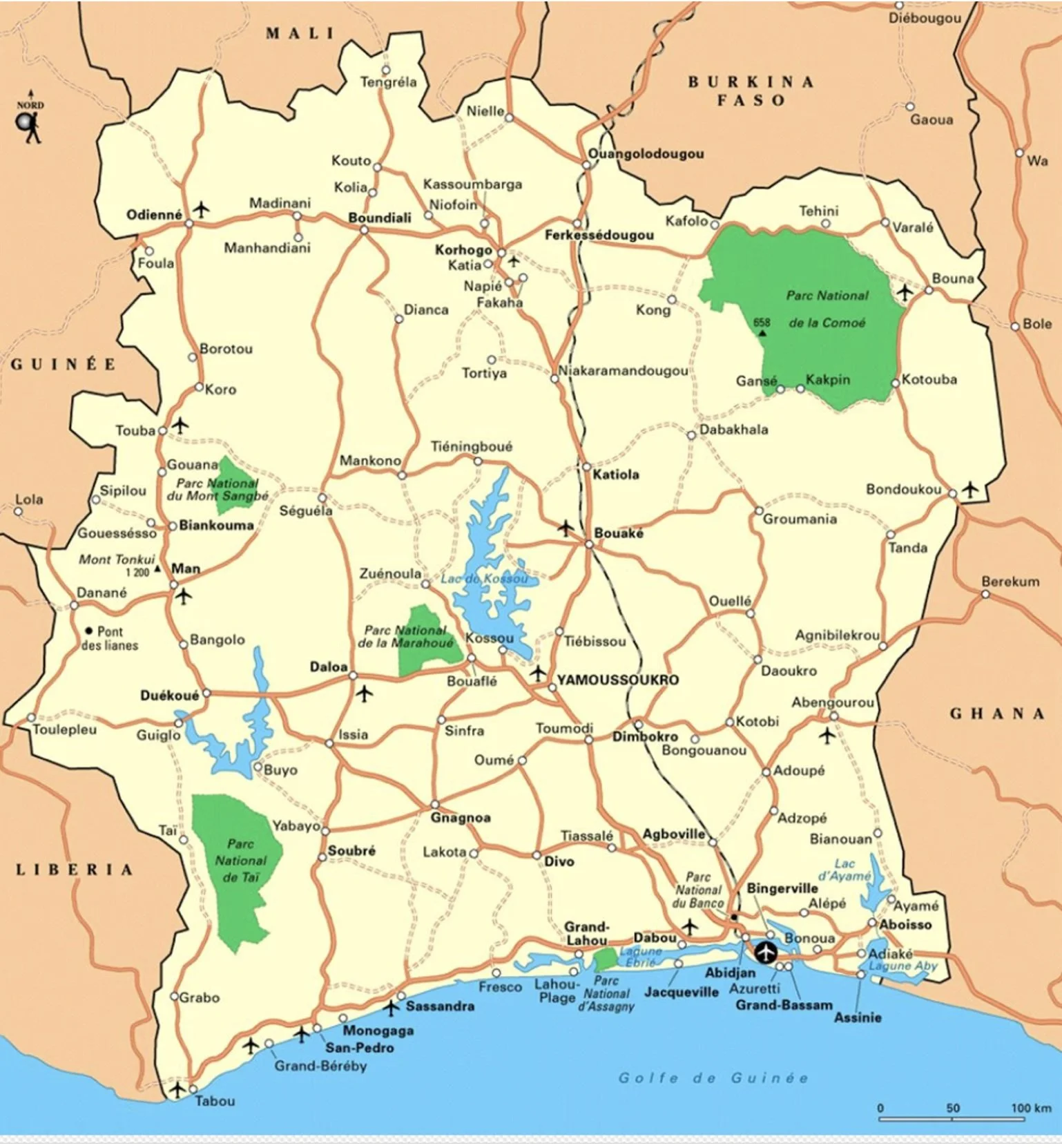
Côte d’Ivoire, also known as the Ivory Coast, is another of those creations from the scramble for Africa that took place between 1840 to 1914, by which time 90% of Africa was under European control. It borders Guinea to the northwest, Liberia to the west, Mali to the northwest, Burkina Faso to the northeast, Ghana to the east and the Gulf of Guinea to the south.
The official language is French but there are some 78 different languages spoken and numerous followers of Islam, Christianity and traditional faiths such as Animism. It became a protectorate of France in 1843, a French colony in 1893 and independent in 1960, led by Félix Houphouët-Boigny, who ruled the country until 1993. Its economy is largely based upon agriculture. It is the world's largest exporter of cocoa beans and exports large quantities of rubber and sugar.
Abidjan is the economic centre of the country but Yamoussoukro, with a population of around 250,000 and lying 240 km northwest of Abidjan, became the legal capital of the Ivory Coast in 1983. It is no coincidence that Yamoussoukro is the birthplace of Felix Houphouet-Boigny and that it is home to the largest church in the world – the Catholic Basilica of Our Lady of Peace.
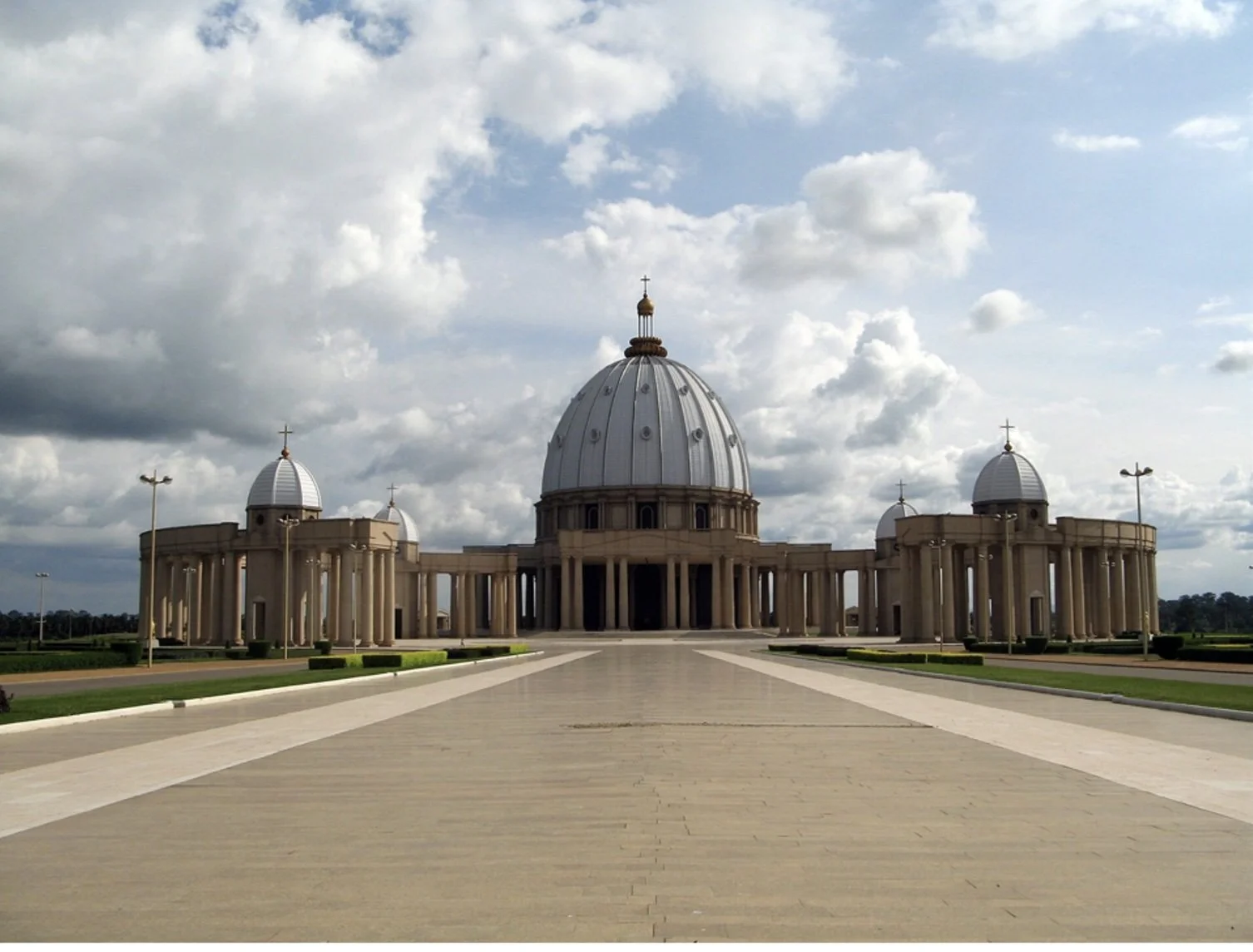
The Basilica of Our Lady of Peace
The Catholic Basilica in Yamoussoukro[1]
The Catholic Basilica of Our Lady of Peace in Yamoussoukrosurpassed the previous record holder, Saint Peter's Basilica, upon completion. It has an area of 30,000 square metres and is 158 metres tall.[3] However, this includes a rectory and a villa (counted in the overall area), which are not strictly part of the church. It can accommodate 18,000 worshippers, compared to 60,000 for St. Peter's.[4] Ordinary liturgies conducted at the basilica are usually attended by only a few hundred people.[5] The basilica is administered by Polish Pallottines at a cost of US$1.5 million annually.[2] The basilica was constructed between 1985 and 1989 with different cost estimates given by various groups. Some stated that it cost US$175 million,[6] US$300 million,[7] or as high as US$600 million.[8] The designs of the dome and encircled plaza are clearly inspired by the Basilica of Saint Peter in Vatican City,[9] although it is not an outright replica.[10] The cornerstone was laid on 10 August 1985,[11] and it was consecrated on 10 September 1990 by Pope John Paul II, who had just formally accepted the basilica as a gift from Félix Houphouët-Boigny on behalf of the Catholic Church.[12][13]. The basilica is not to be confused with the cathedral. Our Lady of Peace which is located in the Diocese of Yamoussoukro; the Cathedral of Saint Augustine – less than 3 km (2 mi) away[14] — is smaller in size than the basilica but the principal place of worship and seat of the bishop of the diocese.[15] While designing it after the Vatican Basilica, Lebanese architect Pierre Fakhoury constructed the dome to be slightly lower than the Basilica of Saint Peter, but ornamented with a larger cross on top.[16][17][18] The finished height is 158 metres (518 ft).[18] The dome is more than twice the diameter of St. Peter's in Rome, 90 metres versus 41 metres (300 ft versus 136 ft). The base of the dome is much lower than Saint Peter's, so the overall height is slightly less. The basilica is constructed with marble imported from Italy and is furnished with 8,400 square metres (90,000 sq ft) of contemporary stained glass from France.[19]
[1] With thanks to Wikipedia
Abidjan was, and remains, a major hub for airlines flying to West Africa (whether from Europe or from across Africa), houses the headquarters of the African Development Bank and the West African HQ of the World Bank and was a popular stopping off point with its hotels, restaurants and entertainment - a quiet shadow of Paris. Bizarrely, in September 1970 the President attended the Gala of the opening of the first ice rink in Africa in the Hotel Ivoire! And like much of Africa, the country has experienced conflict, notably in two civil wars – the first from 2002-7 and the second in 2011.
My first visit to the country was in 1977. As Minster Agriculture we had been contracted to provide an irrigation engineer for a large sugar cane development near Ferkessedougou in the north of the country, where there were already several such schemes. My visit was purely supervisory. My main memory is marvelling at the ease with which two large Caterpillar D8 bulldozers, pulling a heavy chain between them, were able to smash through the bush before it was piled up and burnt.
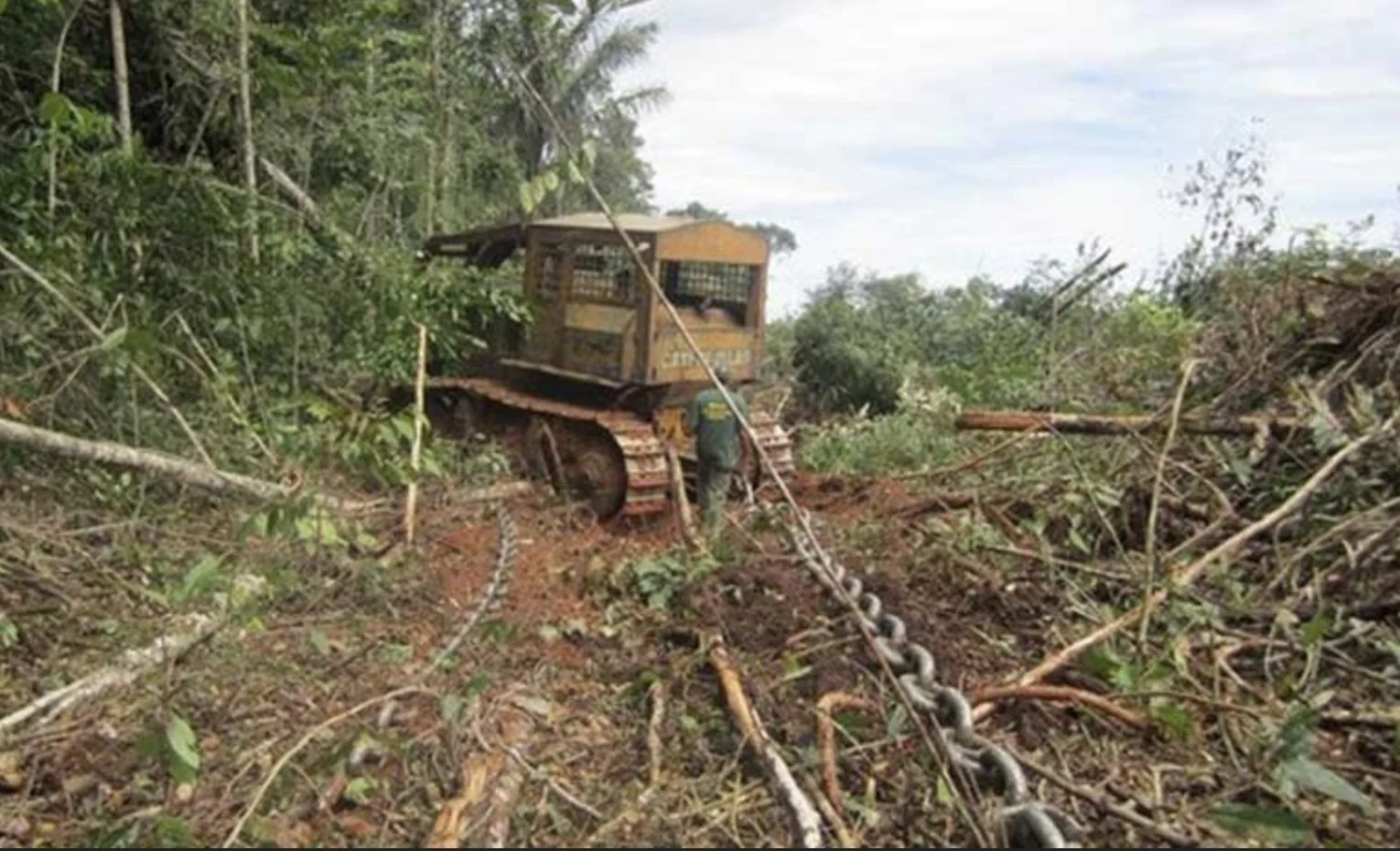
I find it extraordinary now that, at the time, I had no real sense of the destruction of nature that was taking place, of the animals that were losing their homes or of the soil that would soon be baking in the sun. This was progress. This was development. This was going to provide jobs for young people in the area and foreign exchange to fund schools and hospitals. I was blinded to the destruction that was taking place, unaware that sugar was going to fuel a global obesity epidemic and the idea of the revenue from such investments funding the world’s largest church in the President’s birthplace had yet to emerge.
It wasn’t until December 1989 that I travelled there again. Some years previously, the Swiss Government had provided a loan of US$30 million to the government of Cote d’Ivoire, which it now lacked the foreign exchange to repay. As a compromise, the Swiss agreed to write off the loan if the government established an agricultural development bank with an equivalent amount of capital in local currency (CFA). It asked a Swiss Development Bank to undertake the feasibility study which in turn hired me – together with a team of three others, all of whom were fluent French speakers.
The work involved travelling throughout the country getting to know what was going on in the agricultural sector and then coming up with a portfolio of investment opportunities that the new bank could finance.
Having studied French to A level, I had a reasonable grasp of the language, particularly if required to quote Molière or Racine (whose plays I had studied at school) but little experience of face-to-face conversation. As my work continued to take me to French-speaking African countries (including the DRC, Congo Brazzaville, Cote d’Ivoire, Guinea, Gabon, Cameroon, Togo and Algeria) I felt the need to improve my French by making a series of lined cards on which I would write a list of English words and their French equivalent under different headings - verbs, adjectives, adverbs, nouns etc – which I would endeavour to memorise…. just as I had done when taking my undergraduate degree finals. From this I then produced a pocket-note book full of words in both languages – many of which were related to agriculture – tractor, plough, cow, soil etc. I was never fluent but seemed to be able to hold my own.
As a complete aside, in 2015 Fiona and I went to New Zealand – for the first and only time – after visiting some of her relatives in Australia. We spent four days kayaking along the north coast of the South Island and in our party was a French couple. Francoise was always immaculately dressed and we learned that she was a senior civil servant! However, as we went through the safety briefing before pushing out to sea it became clear that they were struggling to understand the English, probably made more difficult by the strong New Zealand accent. So I undertook to roughly translate. As we continued the exchange, I shared with them my knowledge of agricultural French – with the high point being my referring to a moissonneuse-bateuse - a combine harvester! Such was the resulting mirth that I became known as Monsieur Moissonneuse-Batteuse.
Back in Côte d’Ivoire there were five members of our team. Claude, a banker and the team leader, was Swiss. Jean-Marie was an economist and French. I was British. And we had the good fortune to work with two Ivoirian agriculturalists. We got on well – except in one area, which was our sense of time. When gathering for an appointment Claude, being Swiss, would always be there before time. Having worked in Africa for twenty years I was conscious that time was “flexible” and would arrive just after the set time so as not to embarrass those who might turn up later. The next to arrive would be Jean-Marie, with a Gallic “Pouf” and a shrug of the shoulders. Sometime later, our Ivorian colleagues would arrive at what they perceived as “local time”.
My role was to scour the country for investment opportunities in the agricultural sector that would justify the establishment of an agricultural development bank - and so off I went, on my own or with one of our local colleagues, to different parts of the country. . A second visit would later be required to prepare a potential investment portfolio as the basis for an agreement between the two governments. I enjoyed the experience of travelling but during the trip I found myself feeling unwell, tired and – particularly noticeable – demonstrably losing my ability to talk in French. I came to the conclusion that it was caused by taking Lariam – a malarial prophylactic – and I returned home a few days early to recover. But before that second visit took place there was another reason to visit the country – which led to an unnerving experience at immigration.
In April 1990, some four months after the “Lariam” incident, Fiona and I arrived in Abidjan to present to the African Project Development Facility (APDF) the findings from a business plan for the development of two wood-processing companies in Ghana which APDF had funded. We arrived at the airport at dusk and made our way to immigration. Whilst I was allowed to enter, Fiona was held back because she did not have a visa. Getting a visa was not something that had crossed our minds as I had never required one – forgetting that this would be needed by a non-EU/Malaysian citizen. We were immediately taken off for questioning, where we were told that whilst I could go through immigration Fiona would have to stay in the airport until I returned – and that they had a “small room” nearby where she could stay. My explaining the vital purpose of our mission appeared to make no impact. But in response to my persistence they called in “Le Patron” – the head of security. He remained impassive until he turned to me and asked if I spoke English. When I replied in the positive he pointed me to a small group of people in a corner behind bars and asked me to act as his translator. I quickly learned that these were Ghanaians, which allowed me to share with them my local knowledge from working in Ghana and built up some trust. From our conversation I learnt that they had been deported from the US on charges related to drugs and I facilitated a useful dialogue between them and Le Patron. The interrogation completed, he thanked me and said that he was now minded to allow Fiona into the country as long as she left her passport with him until we returned to the airport and left the country. After pressing him further he agreed to give us a receipt – which he scribbled on a piece of paper torn out of a book before tossing her passport into a draw containing assorted items including a couple of pistols. Unsure as to whether we would see it again, we passed through immigration and to our hotel.
The following morning we set off to the offices of the APDF in the West African heat and humidity - only to find that there was a power failure at the office and that the lifts were not working. This would probably not have mattered were their offices not on the 14th floor. Besuited, and carrying our laptops (which in those days weighed around 5kg), we worked our way slowly to the 14th floor – arriving with our moist clothes clinging to our backs. It was with considerable relief that we learned that the office had sufficient battery capacity to power the projector and the laptops that we had lugged up the fourteen flights so that we could present our slides and our findings. The meeting successfully over, we found our way down to the ground floor and took a taxi to the airport - with all fingers and thumbs crossed that the passport would still be there. It was a surprise and relief to find that the scrap of paper was sufficient to gain us access to Le Patron, who was “on-seat” and who rifled through the desk drawer to find and return her passport. Relieved, we made our way through immigration for a stiff drink and take-off to Paris.
When the need came to return for the follow-up work on the “Swiss” project, given my earlier “Lariam” experience I was reluctant to do so – particularly as I would need to work in French. Happily, as my presence was both appreciated and needed, I was able to negotiate an agreement whereby they would cover the costs of Fiona accompanying me in case I felt unwell. And so the two of us arrived at Abidjan airport again, this time with a visa clearly stamped in her passport.
One of our major field trips was to Korhogo, way up in the north of the country - at the same latitude as Ferkessedougou.
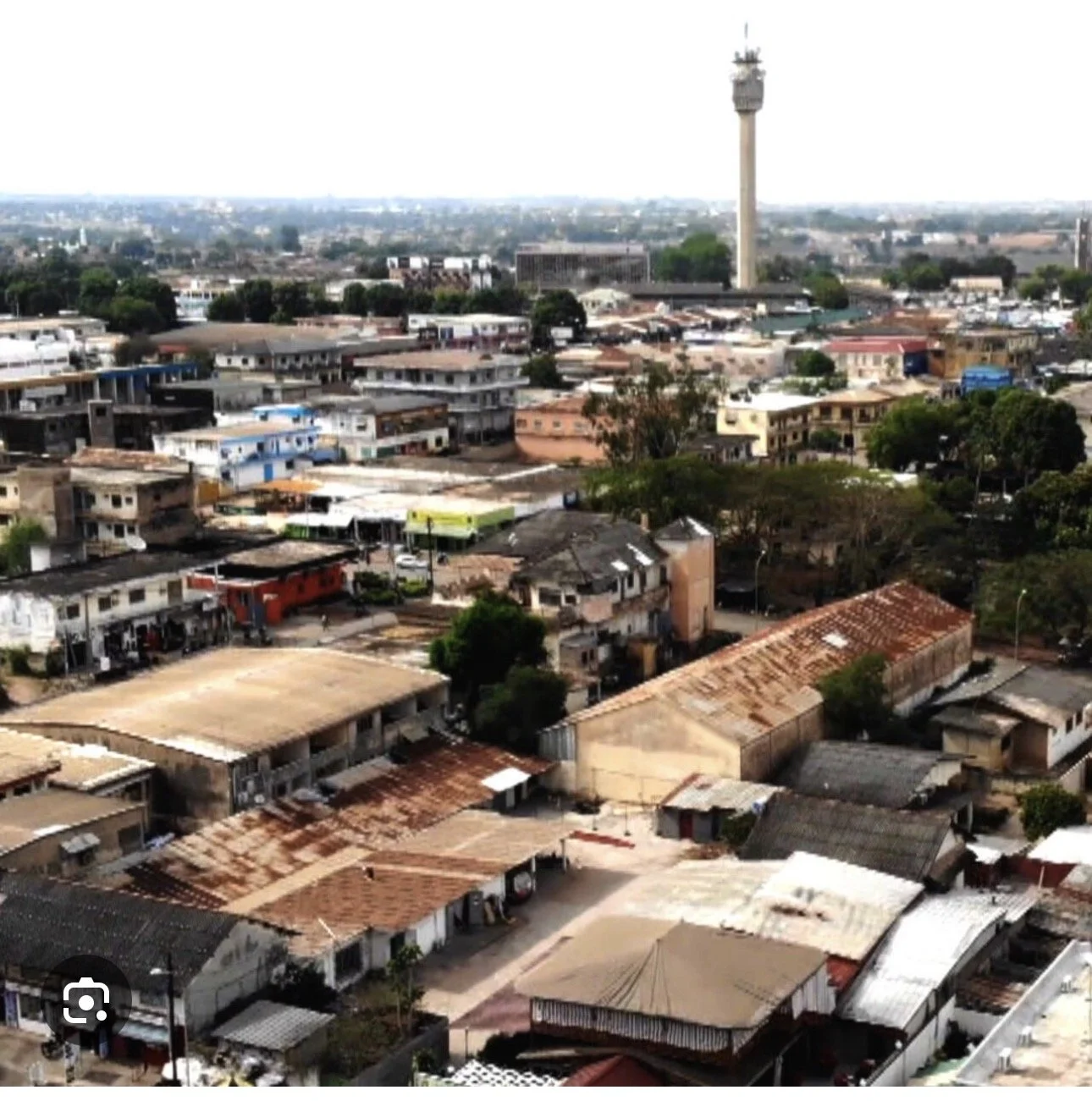
Korhogo
Although we were able fly there directly from Abidjan we had to return by bus – planning to break the journey by staying overnight at Bouaké– some 225 km or four hours’ travelling south. We arranged to get the 1800 bus, which was due to arrive at Korhogo around 2200. Standing at the bus station, 1800 came and went and no bus. It arrived around 1930, only to find that there was a problem with the brakes. Whilst we waited and chatted, we were told by our fellow-passengers of the dangers of travelling overnight, of bandits and of the importance of not stopping anywhere – a thought which remained with us when the bus - something like the one below - finally departed around 2230.
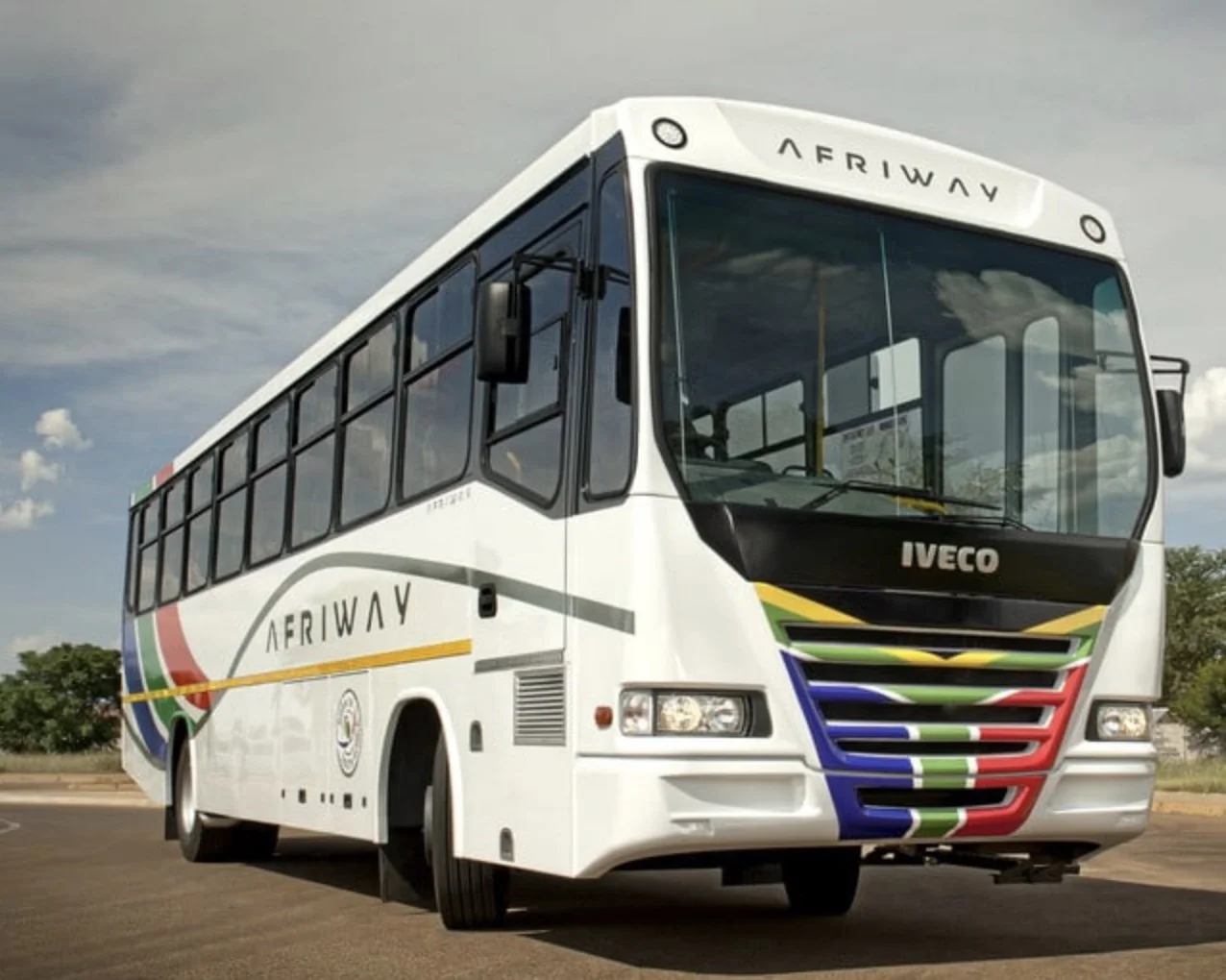
We had not gone more than an hour when the driver asked the passengers if they would mind if he pulled off for a break and a snooze - as he had already driven the 750 km from Abidjan to Korhogo and was – not surprisingly – tired. There was a roar of disapproval from the bus so the poor man had no option but to continue. It was around 0030 in the morning that the bus slowly came to a halt and all the lights went out. The dynamo had failed.
Looking around the bus after a few minutes we saw that our fellow-passengers, all Ivorians, had fallen asleep- either resigned to the situation or finding the experience not unusual. We tried to think positively – reaching (at the time) two important conclusions. The first was that there were no mosquitos and the second was that we had with us a small bottle of wine. Thus encouraged, we consumed the wine and slept-fitfully – until we heard the driver call us to attention to note that it was dawn, that “God has given us light” and that we could now continue without headlights. But to do so we would need to kick-start the bus. With everyone decanted to make it lighter, a party of willing men got behind the bus and pushed until there was sufficient momentum for the driver to engage a gear, for the bus to shudder like a startled hippopotamus and for the engine to start in a cloud of diesel fumes.
Reunited with our seats, we set off and arrived in Bouaké in time for breakfast and to catch the next bus onwards to Abidjan.
On hearing our story our Ivorian counterparts simply observed: “Ah, vous avez bien pénétré l’Afrique.”